Weekend Reading on Women’s Representationis a compilation of stories about women’s representation in politics, on boards, in sports and entertainment, in judicial offices and in the private sector in the U.S. and around the world—with a little gardening and goodwill mixed in for refreshment!
From teammate to teammate, the staff at RepresentWomen will give you our must-reads for women’s representation from this week.
First up, hear fromKatie Usalis, RepresentWomen’s strategic partnerships director:
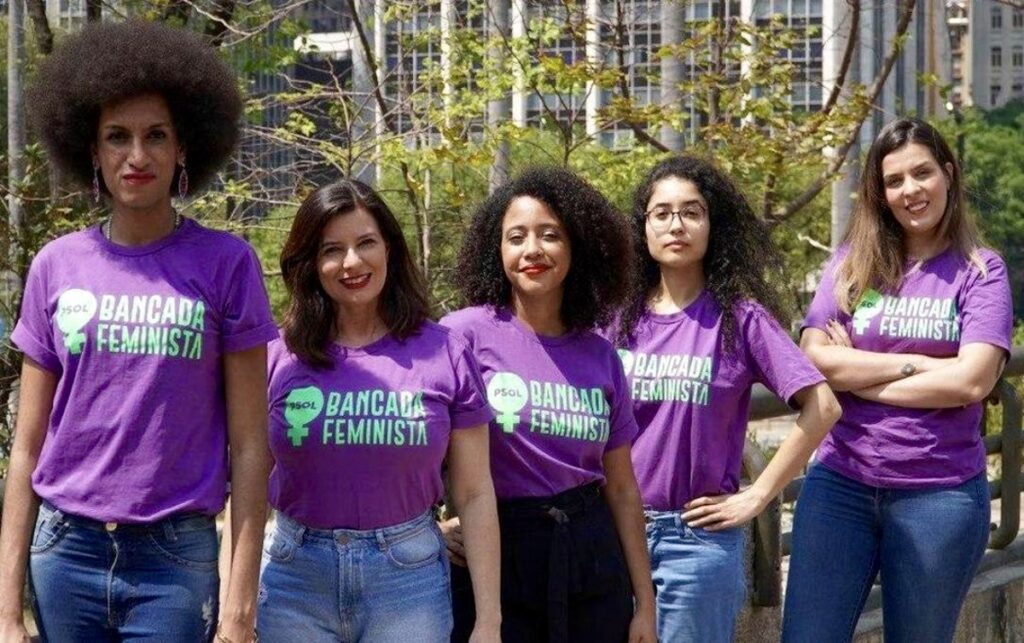
Members of the Bancada Feminista collective, a play on words with Bancada Feminina, the legislative “Women’s Bench” that has served to segregate and isolate women from party decisions in parliament. (Rede Brasil Atual)
Latin America is famous for its mobilized and innovative citizens, especially women, who courageously face challenges and solve problems in their communities and regions. Jill Langlois ofNational Geographicreports on one particular political innovation that first appeared on the scene in 1994: political collectives. While not precisely sanctioned by law, they are a unique way that Brazilians are taking representation into their own hands. Langlois writes:
Though not formally recognized by the government, power-sharing political seats are part of a growing trend to broaden the scope of representation and increase the number of female and minority officeholders…
Gaining political representation is a challenge faced worldwide by women, people of color, the LGBTQIA+ community, and other minorities. But only in Brazil have so many grassroots activists—like the members of Bancada Feminista, which means Feminist Bench—set about unofficially sharing elected seats to amplify marginalized people’s power.
It works straightforwardly: The political collective puts one member’s name on the ballot but campaigns as a group. The person on the ballot serves as the group’s spokesperson and, as the only officially elected representative, is the one who speaks at city council or legislative assembly meetings and casts votes. The other members serve constituents or provide expertise in specific areas; decisions on how to vote are made as a group.
Langlois explains that political collectives started when Durval Ângelo, a Workers’ Party candidate for state representative, regularly invited the public to give feedback on his plans and proposals and help him decide what to do next. It might come as no surprise that he served for six consecutive terms. “Gradually, the idea evolved into sharing seats.
From 1994 to 2018, 94 political collective candidates participated in the country’s elections in 110 campaigns. But in the 2020 municipal elections alone, 313 collectives ran—and 22 of them won.”
“Sharing” seats by creating a collective, or a team of decision-makers that support an elected spokesperson, creates more opportunities for diverse voices to come to the table. It also helps elected officials stay better connected with the communities they represent. Nunes, an attorney interviewed by Langlois, said, “If it were just one person holding this seat, so many people in our community would be left behind. That one person would be stuck in council meetings, casting votes on issues affecting people they didn’t even have the time to meet.”
Nothing is perfect, but the lack of legal recognition and regulation can create challenges, and if the officially elected spokesperson steps down, the entire collective loses its voice. So far, the political collectives can adapt to changes and disruptions. It’s incredible what mobilized citizens can accomplish without the political will to make significant changes at the top.
Next up, we have a new report overview from RepresentWomen research directorCourtney Lamendola:
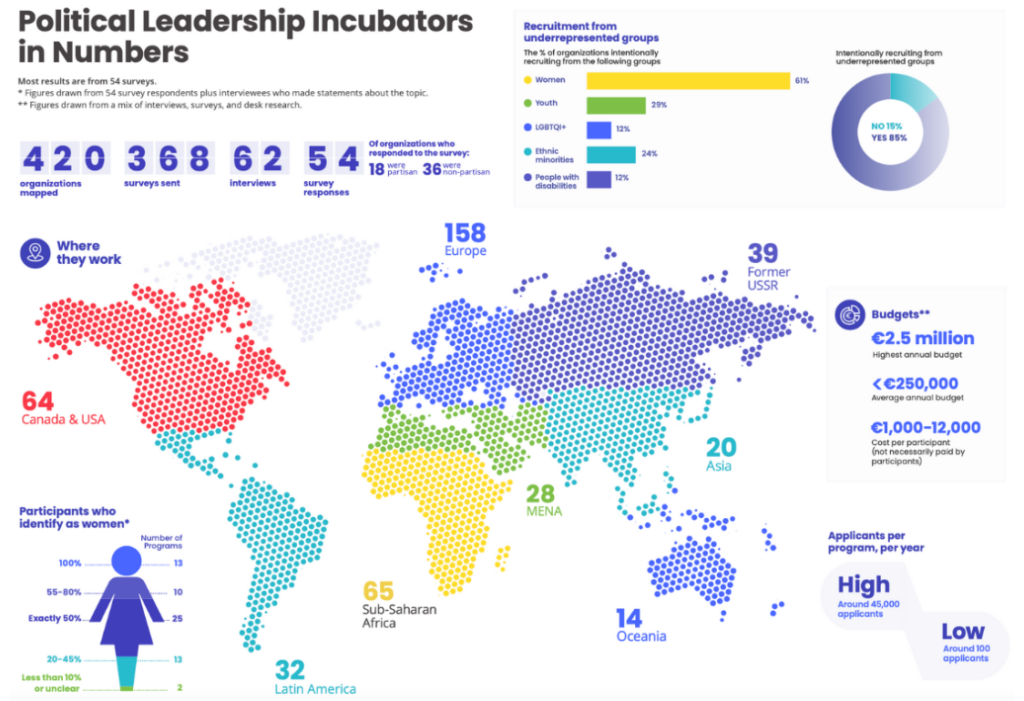
Earlier this week, theApolitical Foundationlaunched itsfirst major reporton the political leadership incubators (PLIs) recruiting, training and supporting future politicians worldwide: “Better Leaders, Better Democracies: Mapping the Organizations Shaping 21st Century Politicians.”
According to the report authors, this report is the first. It broadens the definition of “candidate training organizations” by including organizations that incorporate recruitment, screening, training, policy-based education and ongoing leadership support and accountability in their scope of work. To this end, the report authors refer to the organizations they studied as “political leadership incubators” or “PLIs” to be more inclusive:
“This approach, which we developed and discussed during interviews with organizations, highlights the need for PLIs to broaden their thinking beyond training and into recruitment, activation, and support for political leaders. It suggests that PLIs work with leaders well after they have been elected to office, for example, by offering mental health support, access to peer networks, ongoing training, etc. PLIs who do not continue to teach, support, and hold accountable elected alumni risk losing their investment.”
The scope of the report’s PLI mapping efforts is also the first. The report authors mapped 420 PLI organizations worldwide and conducted outreach with them through surveys and interviews. As many as 85 percent of these organizations work with underrepresented groups (including women, youth, LGBT+, ethnic minorities and people with disabilities).
While 61 percent of the mapped PLIs work with women, the report’s authors argue that there are still too few groups to address the scale of the global gender gap, which theWorld Economic Forumestimates will take more than 100 years to close.
Of the gender-focused PLIs in the U.S., the report shows that the U.S. and Australia were “hotspots” for programs that focus exclusively on women’s leadership and 48 percent of all PLIs in the US-run women-centric programs. The only PLI credited with working with people beyond the gender binary is theLGBT Victory Institute, which is also based in the U.S., though it operates globally. Three US-based PLIs also appeared on the Apolitical Foundation’s “28 Non-Partisan Political Leadership Incubators to Watch” list:Higher Heights,IGNITE, andRun for Something.
Overall the report and work done by the Apolitical Foundation provide fascinating insights into the role and potential of political leadership innovators around the world. And their emphasis on knowledge sharing, data-backed strategies and collaboration as a lever for systemic change presents a roadmap for making democracy work in challenging times.
Now, let’s hear from RepresentWomen researcherGrace Beyer:

When those rights are on the eve of being taken away, it’s essential to reflect on the impact they have had on women for the past several decades. Scientific American’sinterviewwith the author of the landmark Turnaway study followed the outcomes of women who wanted abortions and either got them or were “turned away” and unable to get one.
The outcomes were stark. Women who could not fulfill their choice to get an abortion had far worse health outcomes—indeed, two women died in childbirth. With many states having so-called “trigger laws” to ban abortion ifRoegets overturned, excluding even an exception for the mother’s life, these cases are likely to become all too common.
Health wasn’t the only difference: economically, women without a choice fared far worse. Both groups of women had roughly equal credit scores before attempting to get an abortion, but the ones denied their choice had their credit scores sink and chances of being in poverty climbed. It’s not just the women who suffer. Many of these women already had children, and these children were found to be more likely to live in poverty and miss critical developmental milestones. Pro-choice is pro-family: Pro-life is pro-birth.
On the midterms watch is research associatePaige Chan:
On Tuesday, May 3, 2022, Nan Whaley won the Ohio Democratic party’s nomination for governor with 65 percent of the vote, becomingthe first womanin Ohio’s history to win a major party nomination for that race. Whaley and her running mate, Cheryl Stephens, are the first all-female ticket nominated by a major party for governor and lieutenant governor.
If Whaley won the general election, she would be the first woman elected. Ohio has only had one female governor, Nancy Hollister, who stepped in to fill a vacancy in 1998 and served for only 11 days.
Ohio has also lagged in women’s representation outside of the governor’s seat. In RepresentWomen’s2021 GPI Index, Ohio ranked 43rd out of 50 states. For instance, Ohio has never sent a woman to the U.S. Senate, with that trend continuing in 2022. Both winners in the 2022 primaries from the major parties weremen.
One cause of Ohio’s lack of gender parity in the political culture. Ohio state Senator Nickie Antonio described Ohio politics as still an “old boys’ club,” making it intimidating and exclusionary towards women. Other reasons Ohio lags are structural barriers—the cost of campaigns combined with a wage gap and childcare responsibilities that fall disproportionately on women’s shoulders.
Ohio has far to go before they become a leader in gender parity. Yet, electing Nan Whaley in the gubernatorial general election would be a significant step towards that goal.
And lastly, hear from digital managerKaycie Goralon the future of the GOP:
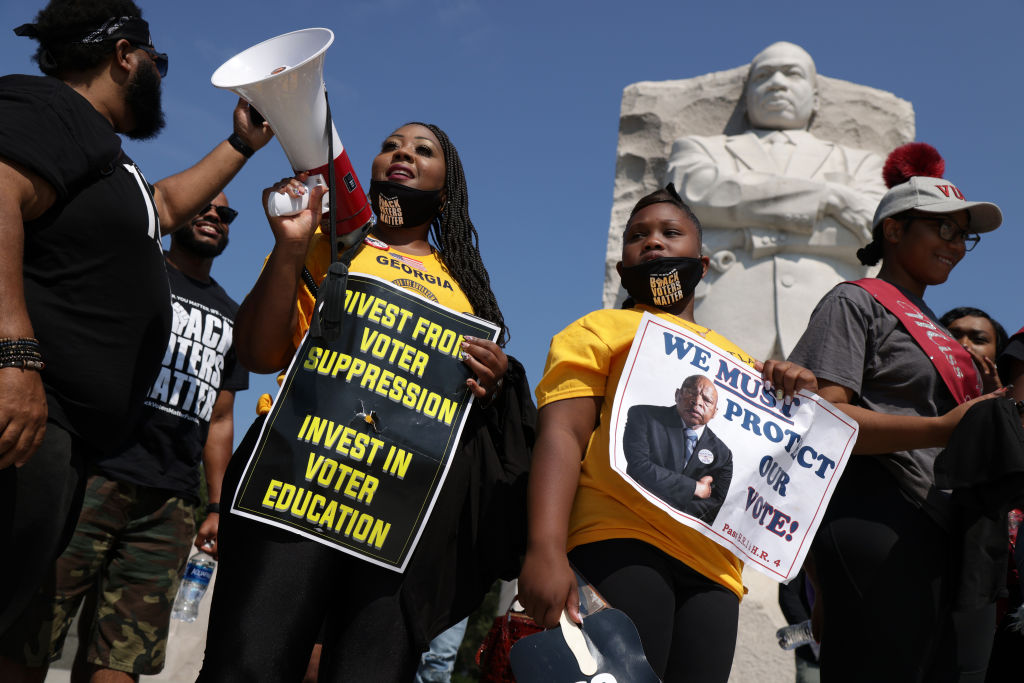
Voting rights activists from Atlanta participate in a “Freedom Friday March” protest on Aug. 6, 2021 in Washington, D.C. (Alex Wong / Getty Images)
The 2022 midterms are shaping up to make the GOP the most diverse it has ever been. In his opinion piece for the Washington Post this week, Conservative columnistHenry Olsenhighlights therecord number of female and minority members running for and winning GOP seats this election cycle.
“President Bill Clinton famously said he wanted a diverse Cabinet thatlooks like America. The emerging Republican majority will both look and think like Americans. That combination will be hard to beat.”
Given current polling, theNational Republican Congressional Committee’scandidate pipeline indicates a growing number of women and minority candidates running in solidly Republican races. Adding these members to the Republican caucus would make next year’s House GOP the most diverse it has ever been.
A couple of notable races feature this trend for GOP candidates. Last Tuesday’s Primaries featured a win for conservative commentator Madison Gesiotto Gilbert vying for the Ohio party’s 13th district nomination. Former state Sen. Erin Houchin claimed victory in the crowdedIndiana ninth congressional district Republican primary, a feat proving money isn’t everything in an election. Later this summer, in Alaska’s historically crowded congressional race Sarah Palin and others will become a GOP focal point.
This extends to the Senate withKatie Boyd Brittin Alabama,Kathy Barnettein Pennsylvania, Trump-endorsedKelly Tshibaka, who could unseat Alaska Incumbent Sen. Lisa Murkowski, andHerschel Walkerin Georgia. Walker is projected to go head to head with Democratic Sen. Raphael G. Warnock in what will probably be the most contentious and watched race these midterms.
Gubernatorial racesexhibit this move toward more diverse candidates for the GOP. Look no further thanArizona’s GOPrace, where women outnumber male candidates Three to Two, with Trump endorsing one,Kari Lake. Former lieutenantGov. Rebecca Kleefischis the GOP primary front runner in the perennial swing state of Wisconsin, and Alabama incumbentGov. Kay Iveyis batting away challengers with an ad demonstrating hershooting skills. Trump press secretarySarah Sandersis also on track to become Arkansas’s next governor.
While Olsen argues that this trend is occurring because women and minorities have built up their political capital enough to bid for high office. Party leaders know that if they do not support more of these candidacies, they will risk losing support among the nation’s growing female and minority voter base.
RepresentWomen knows that our government’s movement toward gender balance and overall descriptive diversity is slow-moving and incremental. When we see headlines like Olsen’s touting “record-breaking” or “historic” numbers of women or minorities in the field, it’s essential to look at that record critically. What was that surpassed number? By how many candidates did we move forward? Is breaking the record statistically impressive when the country stilllags behind most of our alliesin terms of representation?
Yes, this is a vastly encouraging trend for the future makeup of the GOP. But suppose we want to achieve gender balance in all facets of our politicsthislifetime. In that case, we must invest in systems solutions and a great agitation of entrenched political barriers for women and POC candidates, regardless of party.
P.S. Check out founder and executive director of RepresentWomen Cynthia Richie Terrell’slatest pieceinMs. on the leaked SCOTUSRoeopinion.