I have spent a lot of my career sitting in rooms feeling frustrated that the people building the data and the people using the data rarely speak to each other. Researchers publish, practitioners cite, and the two groups nod at each other from a respectful distance, and I have often wondered what all of us miss because of that distance. This past weekend, at the American Political Science Association’s (APSA) annual meeting in Boston, I got to see what happens when that distance closes, even just for a few days.
The conference convened this year under the theme “Democracy Under Threat: How to Understand, Protect, and Rebuild,” and it certainly felt like the right conference to be attending at one of the most important moments for our democracy, one where we arrived not only to listen, but to present original research of our own under the banner of the RepresentWomen Research Institute. We have always been driving research, collecting the data and building the tools that inform our work, but this was the first time that we packaged that research and brought it directly to a room of the leading academics around the world in a meaningful and powerful way.

Presenting at APSA was a milestone that marks a real shift in how we think of ourselves and our work, moving us from an organization known for its applied research to one directly presenting that research to a core audience of fellow practitioners and academics, allowing us to be a meaningful contributor to the field’s understanding of women’s representation and the importance women’s leadership has on outcomes. The levers we study, systems like ranked choice voting, multi-member districts, and proportional representation help more women get elected, which in turn leads to more functional outcomes for governing bodies and greater public trust in democracy itself. And that outcome is not simply what we believe to be true — it is what our forthcoming research paper shows.

I watched from the audience as our Research Director, Courtney Lamendola, presented the new paper that illustrates these findings, which she co-authored with Eveline Dowling of Expand Democracy and Samantha DeRagon, a student at the University of Iowa. The paper asks the question that sits at the center of everything we do: does gender parity affect the gaps we see in political trust and participation? It draws on the Gender Parity Index we built to measure how closely every level of American reflects the people it serves, and it argues the answer is yes. Courtney made that case to a room of experts in the field, and we received thoughtful and overwhelmingly positive feedback we are now incorporating as we prepare the public for public release in the coming months.
What struck me most, watching that exchange between practitioners who spend their days both using data and generating it through the vehicles of their own work, was how much appetite there is in this space for exactly what we have built at RepresentWomen. A reviewer who heard Courtney’s presentation told her the Gender Parity Index was fantastic, and is a tool the field needs to be using. I have heard versions of that sentiment before, but hearing it from a researcher whose job is to interrogate data for a living landed differently for me. It confirmed something I have believed and built this work around for decades: that the structural changes we advocate for are not simply values we hold, they are backed by evidence that stands up to scrutiny.
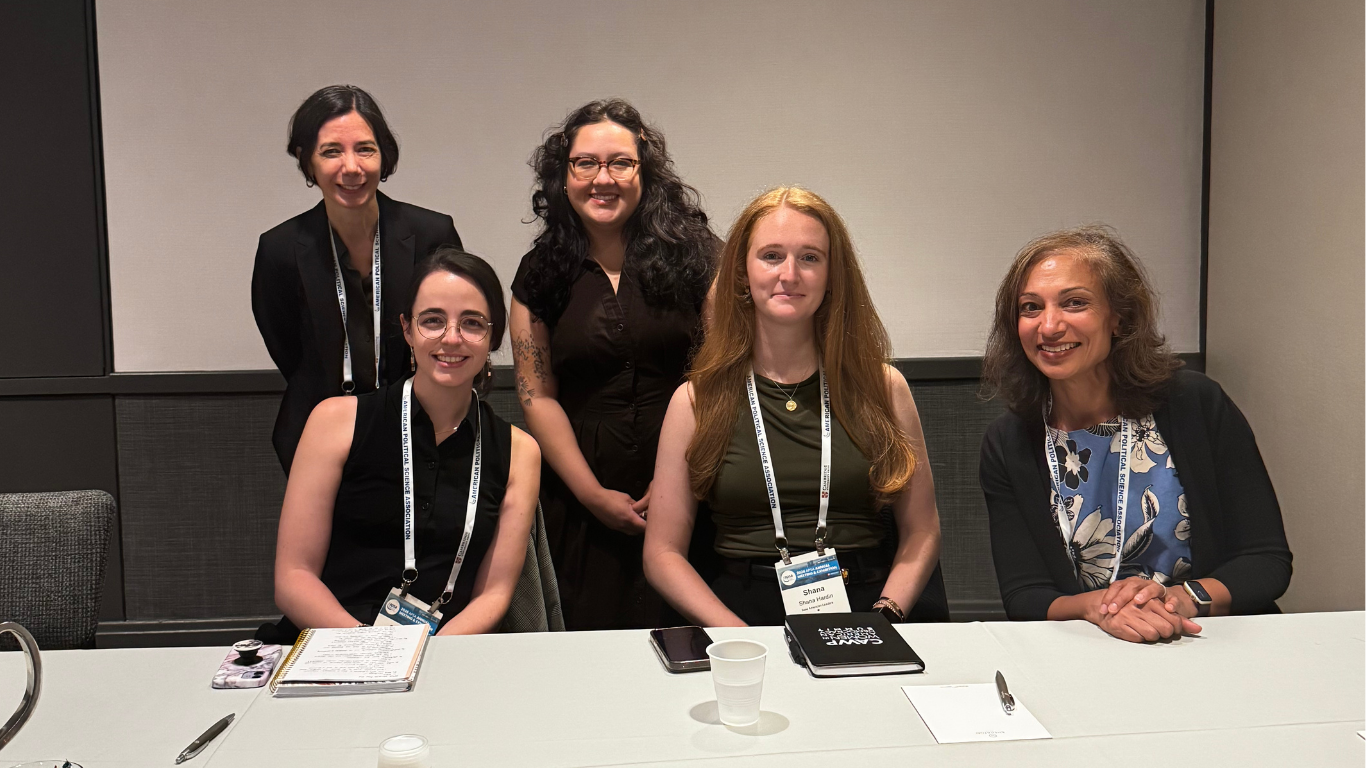
We also convened a roundtable with partners from the Center for American Women and Politics, Vote Mama Foundation, and New American Leaders, using the Gender Parity Index as a shared framework for a conversation about the structural barriers that still stand between women and political power. It was our third year at APSA, but the first where we were not simply attending. We were shaping the conversation, and that distinction matters. Advancing women’s representation cannot happen through advocacy alone; it requires researchers willing to ask hard questions, practitioners willing to put their data to work, and, increasingly, both sides willing to sit in the same room. I left Boston more convinced than ever that protecting and rebuilding a resilient democracy depends on exactly that kind of collaboration and look forward to being a leader in continuing convening practitioners and researchers together through this work.

Birthdays: Betsy Hodges, former Mayor of Minneapolis, elected with ranked choice voting; Leslie Jones, comedian; Heidi Sieck, co-founder & chief empowerment officer at VoteProChoice; Sarah Hague, former staffer at Vote Mama Foundation; Ruby Bridges Hall, 1st Black child to go to a white school, leading to desegregation of schools; Patsy Cline, singer; Mary Morton Kimball Kehew, first president of the National Women's Trade Union League (1903); Juliana Stratton, Lt. Governor of IL; Courtney Lamendola, Research Director at RepresentWomen; Alison Bechdel, author & cartoonist; Sarah Bonk, founder of Business for America; Alice Brown Davis, first women and Principal Chief of the Seminole Tribe (1852); Mamie Dillard, African American suffragist; Anna Mullins; Maria Bartiromo, television journalist; Yael Bromberg, lawyer and defender of voting rights; Taraji P. Henson, actress; Tuti B. Scott, philanthropist & activist; Dr. Donna Lopiano, major player in women & sports; Jill Alper, political consultant; Wendy Bolger, founding Director of the Center for Innovation & Entrepreneurship at Loyola University, MD; Tarana Burke, civil rights activist who launched the #MeToo movement
Milestones: Alice Stebbins Wells, a former social worker, becomes the first woman police officer with arrest powers in the U.S. (Los Angeles, CA); Margaret Chase Smith became 1st woman to serve in the House & Senate; the Violence Against Women Act (1994) was enacted by President Clinton.

Records Broken in Women Running For Governor

Business leader Helena Foulkes won in a landslide in the Democratic primary for governor of Rhode Island this week, defeating the 75-year-old incumbent Dan McKee by 25 percent. She is heavily favored in November against a Republican and an independent candidate. The Republican nominee may still shake out in a woman’s favor as votes are still being counted with a male candidate just narrowly ahead. Her win follows in the footsteps of other women this week who secured wins in both major party nominations in New Hampshire, where Republican incumbent Kelly Ayotte is favored against Democratic challenger Cinde Warmington.
Women today are governors of 14 states. The November election could result in as many as 24 women governors or as few as four, but my husband Rob Richie’s analysis is that women are favored to be governor of 16 states next year, assuming women win where they are generally favored and win tossup races in Georgia and Ohio. We’ll do a deeper dive of contests next week, but for now we'll highlight this excerpt of a news release from the Center for American Women and Politics.
“With Kelly Ayotte (R) and Cinde Warmington (D) winning gubernatorial nominations in New Hampshire, and Helena Foulkes (D) doing so in Rhode Island, there is a new record for major-party women gubernatorial nominees. In 2026, 27 women are nominees for governor; the previous record of 25 was set in 2022 when the same number of states had gubernatorial contests. This record could still increase: Elaine Pelino is in a contest for the Republican gubernatorial nomination in Rhode Island that remains too close to call. Should she win, there would also be a new record (five) for all-women general election gubernatorial contests. The record, four, was set in 2022 and matched this year.”
Those woman-on-woman governor races are happening in Minnesota, New Hampshire, Oregon and Tennessee. Women are also the nominees of both major parties this year in U.S. Senate races in Minnesota and South Carolina.
Women Have Key Wins in Other Primaries in New Hampshire and Rhode Island

Women had other key wins in this week’s primaries in New Hampshire and Rhode Island, even as Rhode Island has offered key challenges for women. We’ll turn to the Center for American Women and Politics for an initial rundown.
New Hampshire: Women are 3 of 4 (75%) major-party nominees for U.S. House in New Hampshire, including 2 of 2 (100%) Democrats and 1 of 2 (50%) Republicans.
Rhode Island: Women are 3 of 7 (42.9%) major-party nominees for statewide elective executive office in Rhode Island, including 3 of 5 (60%) Democrats and 0 of 2 (0%) Republicans. No women filed as candidates for the U.S. Senate in Rhode Island in 2026. No woman has served in the U.S. Senate from Rhode Island. Kellie Keenan (R) is the sole woman nominee for the U.S. House in Rhode Island. This contest is currently rated as “Solid Democrat” by Cook Political Report. No woman has served in the U.S. House from Rhode Island since 1991.
New Hampshire has been a top state in RepresentWomen’s Gender Parity Index, which is likely to be continued with an all-women contest for governor. Women are favored in both U.S. House races (incumbent Maggie Goodland and Stefany Shaheen, who won a tight open seat primary) and women are likely to make gains in the state legislature. One Senate seat will go to a man, as Karishma Manzur lost her bid in the Democratic primary against Chris Pappas.
Women are likely to win key races in November in Rhode Island including in the race for Lt. governor. Also in Rhode Island, incumbent Sabina Matos held a close Democratic primary, and Kimberly Ahern won a close open seat Democratic primary for attorney general.
Women’s Representation in States Curbing Abortion Rights

Her Bold Move has a new Substack post that I found both sobering and mobilizing. Here’s an excerpt that leads into work being done in Alabama and Arkansas.
In the four years since the Dobbs decision, 22 states have banned abortion. More than 31 million women of reproductive age now live under those bans. Women’s healthcare has become inaccessible – even for expectant mothers – 57.9% of rural counties have no obstetric clinician, and 70.3% lack a hospital with labor and delivery services.
Between 2022 and 2023 alone, maternal mortality rose 8 to 9.2% in ban states, exacerbating a U.S. maternal mortality rate that was already more than double that of comparable countries, and highest of all for Black and Brown women in the South.
And here is the part that should make all of us angry: the states absorbing the worst of these trends are, overwhelmingly, the same states that national Democratic institutions have written off as “unwinnable.” Deep red. Few competitive seats. Low turnout. “Not worth the investment” — or so the thinking goes.
We reject that thinking. That is exactly why Her Bold Move is looking south. Because “unwinnable” is not the same as “unimportant.” The states with the most dangerous laws for women are the states where women need power the most.
Do you know what else those states have in common? They all have male supermajorities in their state legislatures. And there are women in these states who are already doing the work every day to change the lived realities for their neighbors. Those women deserve our attention and our support.
Haaretz oped: “The Israeli Knesset, Where Female Representation Fails Women”
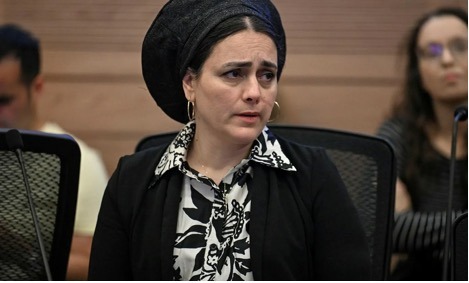
Israel will hold national parliamentary elections on October 27. The New York Times introduces the dozen parties that are positioned to win seats. Notably, every single party is led by a man.
While Israel ranks 95th in the world for women in parliament with men holding 74.8% of seats, that dominant role of men at the top is suggestive of a deeper problem for women in a system where legislators are expected to vote according to the party line. The valuable Israeli newspaper Haaretz ran this important commentary by Shira Vizel about the problematic role of women in government in Israel. It’s one that raises a broader conversation about substantive representation along with descriptive representation. Here’s an excerpt:
The debate over putting more women on party slates overlooks a fundamental question: What kind of agenda will these women bring to the Knesset? The last four years have shown us that female representation devoid of compassion and integrity is not only fruitless, it harms women.
When every day the choice is between a disaster and a Holocaust, issues that were once the bread and butter of politicians, especially women politicians, are no longer relevant. One manifestation of this was my feed's preoccupation with the number of women in Ofer Winter's newly formed party Amcha Yisrael. Will the large number of women on its slate who talk about "voluntary emigration" from the Gaza Strip really change the reality? Perhaps it would have been better if there were no women on the list at all, and the war games and horrors were left to men? ..
Even the trivial assumption that women Knesset members will enact laws to help other women has been blown to bits over the past four years. Already in the first few months of the current government's existence, women lawmakers from Likud and Otzma Yehudit voted against a bill that would have enabled the use of high-tech surveillance and ankle monitors on violent men subject to retraining orders.
Gila Gamliel went even further, voting against a bill in 2023 to combat economic abuse in the family – a bill she herself sponsored seven years earlier. In July 2023, Son Har-Melech proposed a bill dissolving the Authority for the Advancement of Women, and along the way would have removed fundamental concepts from the wording of the law, such as "promotion of gender equality," "discrimination against women" and "violence against women."
Two years later, she succeeded in getting a bill passed in its first vote that would have allowed gender segregation for advanced degree programs at institutions of higher education – segregation that would have created tracks for women only, tracks which are often inferior.
When you internalize all these things, you come to realize that female representation doesn't mean there will be a role model. Somewhere out there, there is a girl who needs protection and sees how the women supposed to protect her have turned their backs on her.
Morocco Reforms 2026 Election Rules to Boost Women’s Representation

Morocco just gave us a striking number: of the 95 women currently sitting in the country’s House of Representatives, 90 got there through reserved regional seats, not by beating men in open competition. In local constituencies, where no structural protection exists, women’s success rate in the last election was under 2 percent.
Ahead of Morocco’s September 23 elections, the government has expanded that reserved-seat system rather than retreating from it. Ninety regional parliamentary seats, nearly a quarter of the lower house, are now set aside exclusively for women as part of a new reform, which the following article in The Arab Weekly outlines:
“Morocco is introducing new electoral and political-party rules aimed at strengthening women’s representation in parliament ahead of the September 23 legislative elections, reserving 90 regional seats for female candidates and imposing new gender requirements on the formation of political parties.
The measures are part of a broader overhaul of the electoral framework intended to increase women’s participation in political decision-making, encourage civic engagement and bring parliamentary representation closer to the principle of gender parity enshrined in Morocco’s 2011 constitution.
Under the new rules governing the House of Representatives, regional constituencies that previously allowed mixed-gender candidacies will be reserved exclusively for women. The 90 seats allocated through those constituencies represent 22.8 percent of the lower house’s 395 seats, providing a guaranteed minimum level of female representation before results from local constituencies are taken into account.
The legislation also seeks to prevent those seats from being lost to men when vacancies arise. In partial elections or replacement procedures, seats in the designated regional constituencies will continue to be assigned to women, closing a potential route through which the proportion of female MPs could otherwise decline.
The system is intended not only as a quota but as a pathway into broader political competition. Women will remain free to stand in open local constituencies, where they can compete directly with male candidates for parliamentary seats.”
The reform also reaches into how parties are built: women must now make up at least a fifth of the party’s founding membership, and parties fielding all-women regional lists of candidates under 35 qualify for financial incentives. While this marks clear and intentional progress through this change in structural design, the gender gap these new rules are responding to is still wide. Women hold less than a quarter of Morocco’s lower house and roughly a tenth of its upper chamber, and they make up less than 9 percent of the leadership boards inside their own parties, despite being more than half the country’s registered electorate.
I read reform stories like this one against that backdrop deliberately, because the numbers make the point better than I can: women’s underrepresentation is a design problem, and Morocco just treated it as one.
INEC in Nigeria Challenges Parties to Take Action on Women’s Representation in Politics

Nigeria’s Independent National Electoral Commission (INEC) put a number on something that gets talked around too often: women were 47.5 percent of registered voters in the 2023 General Election, and just 10.2 percent of the candidates on the ballot. Only three of them won Senate seats. This week in Abuja, INEC gathered party leaders, women’s organizations, and civil society groups and told them plainly that the gap between those two numbers is not going to close on its own. As the article notes, National Commissioner Prof. Rhonda Habor Gumus put it directly:
“‘Despite this impressive participation, women remain grossly underrepresented in elective offices,’ she said.
Gumus challenged political parties to deliberately create an enabling environment for female aspirants and candidates by providing equal access to party structures, campaign funding, media visibility, logistics, mentoring, security, fundraising networks and grassroots mobilisation.
She stressed that increasing women’s political representation would require deliberate action rather than mere commitments and declarations by political stakeholders.
The engagement comes amid renewed calls for political parties and other stakeholders to address structural and financial barriers that have continued to limit women’s participation in Nigeria’s electoral process.”
I think INEC is right to frame this as a demand for measurable action rather than another round of commitments, because that’s exactly the distinction that matters. Nigeria doesn’t have a turnout problem among women. It has a nomination problem, and nomination problems are structural — they live in party rules, funding practices, and candidate pipelines, not in voters’ willingness to show up. Rhetoric doesn’t move any of those levers; rules do. Until Nigeria’s parties change how candidates are recruited, funded, and fielded, the country's electorate will keep looking more representative than its government.
Female Representation in France Needs to Progress Faster

After spending my sabbatical in Europe and some time in France, I found this recent opinion piece, “Female Representation In France Needs to Progress Quicker,” authored by columnist Nick Inman, arguing that it’s time to rectify the imbalance, quite interesting. Inman’s starting point is the Eiffel Tower itself: a frieze of 72 names honoring French scientific achievement inscribed there 137 years ago, all of them men. Next year, if plans hold, the tower will add 72 new names — Marie Curie, obstetrician Angélique du Coudray, physicist Yvonne Choquet-Bruhat, the first woman elected to the French Academy of Sciences — and for the first time, every one of them will be a woman.
Inman uses that correction to ask a harder question: what else in France still runs on the same unexamined default, and what actually fixes it? His answer is the one I find most convincing, because it doesn’t stop at symbolism. France’s 2020 municipal elections required candidate lists to be gender-balanced wherever population size allowed it — an actual rule, written into how candidates are selected, not a hope that parties would get around to it. Inman is candid about the resistance this kind of mandate draws in his recent column in The Connexion, writing:
“‘Positive discrimination’ is often mocked for its woke worthiness, but it does matter.
I sometimes teach groups of engineering students and out of a class of 15, there is never more than a couple of women.
Gender stereotypes still linger. In some ways, we have not made much progress since Eiffel’s time.
Another case of positive discrimination was provided by this year’s municipal elections in which lists of candidates were required to be balanced between men and women, as far as possible.
This can be difficult in villages with very small populations and, of course, it necessitates enough women being willing to serve as councillors.
However well it works, it is a step in the right direction.”
The point he makes about positive discrimination mattering is an interesting way to put it, but I agree with the author that it does, and the reason it does is structural — voluntary balance depends on parties choosing to prioritize it every single cycle, while a rule holds regardless of who’s making the decision that year.
The tower is a fitting place to end this argument, but the streets are where it is being tested next: only 13% of French roads and squares named for a person carry a woman’s name. Town halls could fix that by policy tomorrow. Whether they do is exactly the gap between recognizing an injustice and building the rule that closes it — the same gap the candidate-list requirement was written to close, and the same one still open on every unnamed street corner in France.
P.S.—
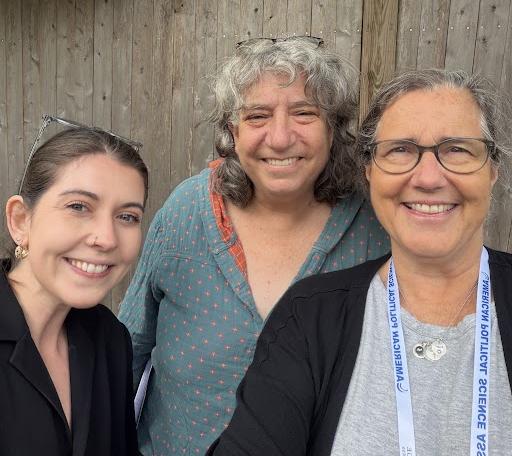
While at APSA I was able to catch up with my longtime friend, Ellen Brodsky – Ellen lives in Cambridge, Mass., a city that uses proportional ranked choice voting that demonstrates just how different voting systems have historically been used in the United States as they implemented RCV in 1941! During our conversation, Ellen shared that while the city implemented these systems over half a century ago, there’s no backup option for state-level offices, requiring people who are used to using RCV to use two different voting systems– Ellen admitted she was sad that she couldn’t rank the candidates in the state legislative race!