
The water lily in my small pond blossomed this week...
Dear supporters of women's leadership in politics,
I struggled this week to find an appropriate story and image to lead with given the killing of children in Texas that follows so closely on the heels of the shooting at the grocery store in Buffalo and so many other senseless deaths due to gun-related violence. While there are undoubtedly many factors that are driving young men to commit these heinous acts of violence it's clear that our antiquated voting system & gridlock in Congress prevent action on gun safety that the majority of Americans support.
Steven Hill writes about the dysfunction caused by our winner take all voting system in Democracy SOS:
The task of the NRA, then—to target their resources to the battleground states and districts like squares on a checkerboard, and try to alarm just enough swing voters there -- is rendered much easier by the geographic-based political map of our winner-take-all system. And it is not too hard to figure out where to target: a 2020 Rand Corporation study found that the 20 states with the highest rates of gun ownership elected almost two-thirds of the Senate’s Republican lawmakers and comprised about two-thirds of the states that President Donald Trump carried in the 2020 election. The 20 states with the lowest rates of gun ownership have more than two and a half times as many residents (about 192 million) as the 20 states with the highest gun-ownership rates (about 69 million).
These kinds of political calculations are intricately connected to the dynamics of winner-take-all’s geographic-based and polarizing two-party structure. In this “swing voter serenade,” small segments of the most uninformed and uninterested part of the electorate, or conversely of the most fanatical parts of the electorate, are bestowed with vastly exaggerated power and able to impact which party wins a majority. They are able to hold hostage any attempt at sane policy, as the middle erodes and legislative bridge-builders disappear.
The impact of swing voters in close winner-take-all district races has not only been frustrating and alienating to the public, but the weight of events illustrates that it has been dangerous to the nation’s health. There was no greater evidence of this than the moving sight of watching family members, friends and loved ones placing flowers on the graves of the innocent victims in Buffalo, Sandy Hook, Orlando, Las Vegas…and now Uvalde. The list is seemingly endless. Welcome to the toxic world of Winner Take All.

New Zealand Prime Minister Jacinda Ardern on Stephen Colbert's show, May 25, 2022
While multiple strategies are needed to solve the gun violence crisis in the United States, a key component is a fair representation voting system in which state legislators and members of Congress are beholden to voters - not to PACs - and as a consequence are more likely to act on policies that voters support.
This conversation between Jacinda Ardern and Stephen Colbert illustrates the powerful impact of women's leadership and fair representation voting that together enabled the parliament in New Zealand to act swiftly after an episode of gun violence. New Zealand adopted a fair representation voting system in 1993 and women now hold 49% of seats in the lower house of parliament. New Zealand ranks 6th in the world for women's representation and has almost no gun violence.

Successful Teal independent candidates (clockwise from top left): Zali Steggall, Kylea Tink, Sophie Scamps, Allegra Spender, Monique Ryan and Zoe Daniel
Australia, like New Zeleand, uses fair representation voting though it adopted a different form of proportional representation that consists of ranked choice voting in single winner districts for House elections and ranked choice voting in multi-winner districts for the Senate. This piece from FairVote provides some more detail on the system used in Australia.
Women fared well in contests in both chambers of the legislature, according to FairVote’s analysis of performance by gender. In Australia’s House elections, a median of eight candidates contested each seat. Of those eight candidates, a median of three were women. Out of all the candidates contesting House races, 38% were women, which lines up exactly with the 38% of seats won by women. In the Senate, women won 24 of the 40 contested seats. These results line up well with academic research showing that women fare well in RCV elections—especially proportional RCV elections.
Among the successful female candidates were the six Teal independent candidates, who blended the conservative economics of the blue conservative Coalition with the climate policies of green candidates. The Teal candidates focused on inner-urban, wealthy seats, typically held by moderate Liberals. They were funded by Climate 200, which supported independent candidates who made climate action, political integrity, and gender equality top issues in their campaigns. The Teal candidates headlined a successful election for independent and minor party candidates. The major two parties won a record low of first preference votes, while independents and minor parties won a record high of first preferences. According to incomplete results as of May 25, independents won 10 seats, Greens won four seats, Katter's Australian Party won one seat, and the Centre Alliance won one seat.
Women in Australia hold over 50% of seats in the Senate and have picked up seats in the House after running together as independents on a "teal" slate with a shared commitment to action on the climate crisis. These women candidates won in traditionally right of center suburban constituencies as this article in The Guardian explains - a note to readers, the Liberal Party in Australia has a center right philosophy:
There was a historic move of voters away from the two major parties in Saturday’s Australian election, and towards independent and Greens candidates who campaigned primarily on a stronger response to the climate crisis. So who are these new MPs, and what do they mean for Australian politics as the new Labor government under Anthony Albanese takes power?
Who are the ‘teal’ independents?
Independent candidates who ran on a strong climate platform in formerly safe Liberal party seats have been labelled the “teal” candidates, because they represent a voting base with conservative fiscal politics – blue is the traditional colour of the centre-right Liberal party – combined with green views on climate.
Teal has become the preferred colour for many of the independent campaigns, starting with Zali Steggall, who defeated the former prime minister Tony Abbott in the seat of Warringah, on Sydney’s northern beaches, at the 2019 election.
Most of the teal independents, although notably not Steggall, received some campaign funding at this year’s election from a group called Climate 200. It was established by the Melbourne philanthropist Simon Holmes à Court in 2019 and provided funding to independent candidates who made climate action, political integrity and gender equality the main planks of their campaign – and who could match Climate 200’s contribution with their own fundraising.

IMAGE: AAP/LUKAS COCH
Women voters in Australia played a big role in the election by voting for change -- as this article in Crikey by Amber Schultz explains:Despite changing his tune and voicing support for gender quotas within the Liberal Party last year, Morrison made no moves to improve representation; female candidates were overlooked to run in safe seats by both sides; and a number of Liberal women, including Fiona Martin in Reid, lost their seats.
Instead he had Liberal woman after Liberal woman turn against him — from Julie Bishop declaring men in Parliament weren’t doing enough to advocate for women, to Bridget Archer crossing the floor over religious discrimination, to Julia Banks and Gladys Berejiklian abandoning the party. The list goes on.
Morrison — after intense criticism in 2020 that he had forgotten women in the budget — instead dedicated much of this year’s funding to women, pledging cash to struggling domestic violence shelters. But he failed to address the root drivers of gendered violence or inequality, again focusing on policies that benefit men over women in his campaign launch.
The closest Australia got to an admission that Morrison’s actions weren’t being received well was a promise to be less of a “bulldozer” and to change his leadership style.
This, however, was short-lived. He later said that — even after refusing to meet protesters on the day of the women’s March 4 Justice rally (telling women they should be grateful they weren’t shot) — if he had his time again he wouldn’t change a thing.
We knew it was coming. Women and strong female independents led the revolution against the Coalition. Morrison time and again underestimated the wrath of angry women — and it cost him the election.
The results are a reason to smile for those who make up the largest voting cohort in Australia.
There are a few more articles on the election in Australia that may be of interest - reminder, the Liberal Party has a right of center outlook:
- The Canberra Times: The Election Showed Australians Want Climate Action - the Conservatives Should Listen
- Washington Post: Australia Ousts Conservative Prime Minister Scott Morrison
- On Elections: It Actually Happened - Independent Surge In Australia as Government Changes
- 9 News: Independence Day as Teals Pick Off Key Seats in Liberal Heartlands

Kay Ivy
My husband Rob Richie shared with me a quick take on women gubernatorial candidates and the prognosis looks good for an increase in the number of women governors in 2022 - here is Rob's recap:
There are nine women governors now - 3 Republicans and 6 Democrats. Of these, the following are favored to win re-election - or, in case of Oregon, be replaced by a woman
- Alabama, Ivey (R)
- Iowa, Reynolds (R)
- New York , Hochul (D) - who should win primary pretty easily
- Oregon (Kate Brown, D) - all top three candidates are women, with D favored
- South Dakota, Noem (R)
The following more likely to win than not, but competitive:
- Kansas, Kelly (D)
- Maine, Mills (D)
- Michigan, Whitmer (D)
- New Mexico, Grisham (D) - leans, but not safe
Sarah Huckabee Sanders
There is a good chance for 7 women to win and quite possibly 9 women from the states above and it's possible that 4-6 more women will get elected, including those running for seats currently held by men. Women are favored in:
- Arkansas, Huckabee Sanders (R)
- Massachusetts, Healy (D)
And women have a real shot in:
- Arizona, Hobbs (D)
- Rhode Island - SoS Gorbea (D)
And possible wins in:
- Hawaii, Vicky Cayetano, the former first lady running for Democratic nomination
- Maryland, Republican Schulz
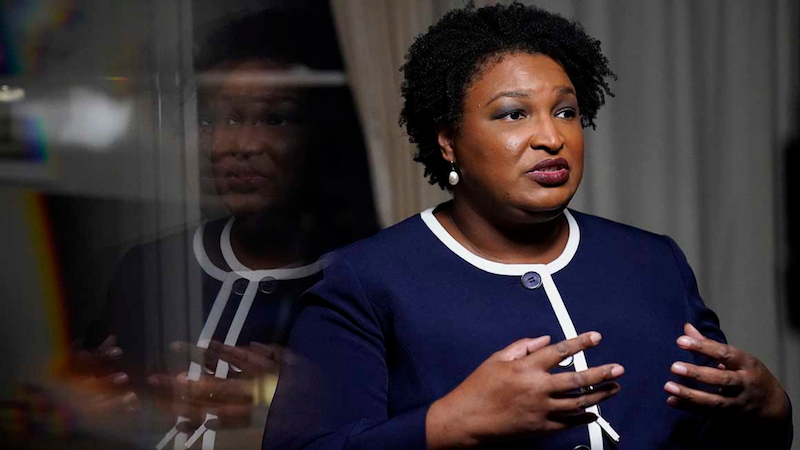
Stacey Abrams
And underdogs:
- Georgia - Abrams (D)
And longer shots in:
- Colorado - Republican woman could well win the nomination, but a longshot against Polis
- Ohio - Democratic nominee against Republican incumbent
- Vermont - Democratic nominee against Republican incumbent
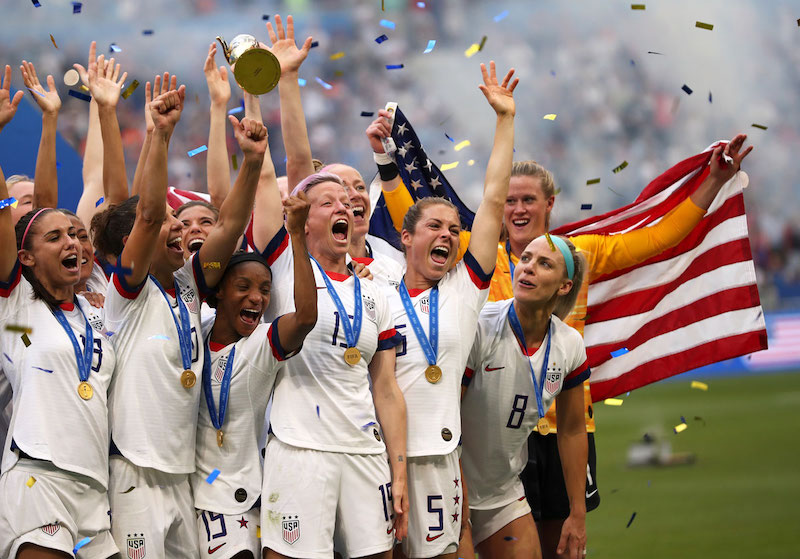
U.S. women's soccer team members
Women on the U.S. women's soccer team won a high-profile legal battle over the right to equal pay that may set the stage for success for other teams - The Washington Post reports:
The U.S. men’s and women’s national soccer teams struck a labor deal that closes the contentious pay gap between the squads, an unprecedented step that will equalize both salaries and bonuses, providing a substantial boost to the decorated women’s team.
The deal was part of new collective bargaining agreements with the U.S. Soccer Federation that were announced Wednesday. It was the culmination of a long battle between the women’s team and the sport’s national governing body, which included a high-profile lawsuit that was settled this year.
The USSF said the agreement makes the United States the first country to achieve equal pay for its men’s and women’s teams.
“To finally get to the point where on every economic term it’s equal pay, I am just really proud,” USSF President Cindy Parlow Cone said.
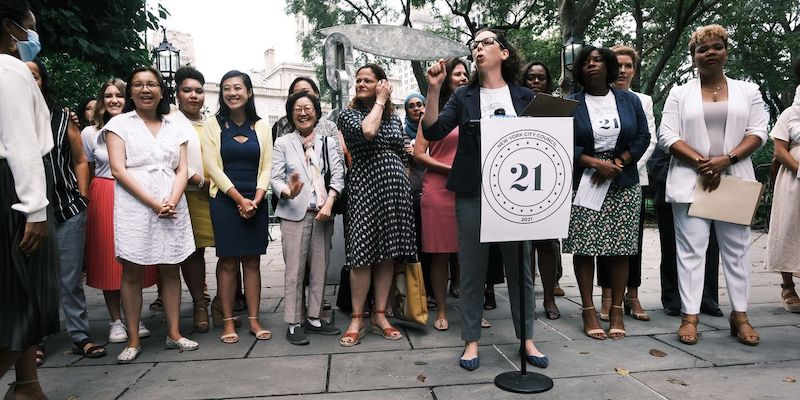
Women gather in front of City Hall to celebrate the first-ever female majority on New York City Council the 2021 primaries. Spencer Platt/Getty Images
We are sad to say goodbye to RepresentWomen research associate Paige Chan as she moves on to graduate school but we are so glad her piece on funding for women candidates in the recent NYC election was published in The Fulcrum! Congratulations Paige - we will miss you!
Last fall, New York elected a majority-women city council for the first time ever. This also happened to be the first time the city used ranked-choice voting and public financing. This is not a coincidence.
RepresentWomen’s research team is currently exploring the ins and outs of that election to uncover all the critical ingredients for such a historic outcome, and we’re looking forward to releasing a full report in June. As an appetizer, let's discuss the campaign finance aspects.
According to the Campaign Finance Board, half of candidates who were supported by independent spenders in the June 2021 primary were women, yet women received only 16 percent of the total dollars given by those donors.
Research also shows that individual donors and political action committees donate more frequently and give more money to male candidates than women, and, with these smaller donor networks, women struggle in crowded political fields.
A deeper dive into the spending data tells us that the mayoral race got much more donor attention than the other races: the total amount of funding in the mayoral race (excluding funds spent on attack ads) was more than 400 percent of the total funds in all the other races combined. Male candidates received 92.5 percent of the mayoral funds.

My daughter Becca Richie & pup Maise read my sister-in-law Marina Richie's marvelous new book - Halcyon Journey: In Search of the Belted Kingfisher
That's all for this week,
Cynthia
P.S. Don't forget to check out this week's suggested reading from the team at RepresentWomen: