.png)
Ten years ago this week, Hillary Clinton became the first woman to secure a major party's nomination for president. I remember the particular kind of hope that came with her nomination, the sense that we were watching a door swing open that could never quite swing shut again. Eight years later, Kamala Harris walked up to that same door and secured her own party's nomination. Two women, two chances, and still, a decade on, no one has walked through it. We have seen more women run. We have not yet seen a woman win the highest office in the land, and the "firsts" we celebrated in 2016 and again in 2024 have not yet become the "next" we hoped for.
That gap, between a historic first and a durable pattern, is exactly why our team spent the first part of this week at the National Conference of State Legislatures summit, putting our newly released 2026 Gender Parity Index directly into the hands of the women legislators, staffers, policymakers, and democracy and representation leaders gathered there from across the country. NCSL was founded fifty-one years ago by legislative leaders who understood that a single moment of recognition means very little without institutions built to sustain it.



That is the same lesson our Index returns to every year, and this year it is especially stark. Candidate numbers for women are up. Campaign funding for women is up, year over year, on both sides of the aisle. And yet women hold exactly the same share of seats at every level of government that they held a year ago: 28 percent of Congress, 30 percent of state executive offices, 34 percent of state legislatures, 27 percent of the largest local offices in the country. The money and the candidates moved. The parity scores did not, and it’s not hard to see why: despite many qualified candidates and nearly $15 billion spent in the last election cycle, incumbents still retained 98 percent of seats in Congress, and fewer than 40 House seats are expected to be competitive in 2026. That gap is what we mean when we talk about a structural ceiling, and it is why we do not measure our progress in firsts alone.
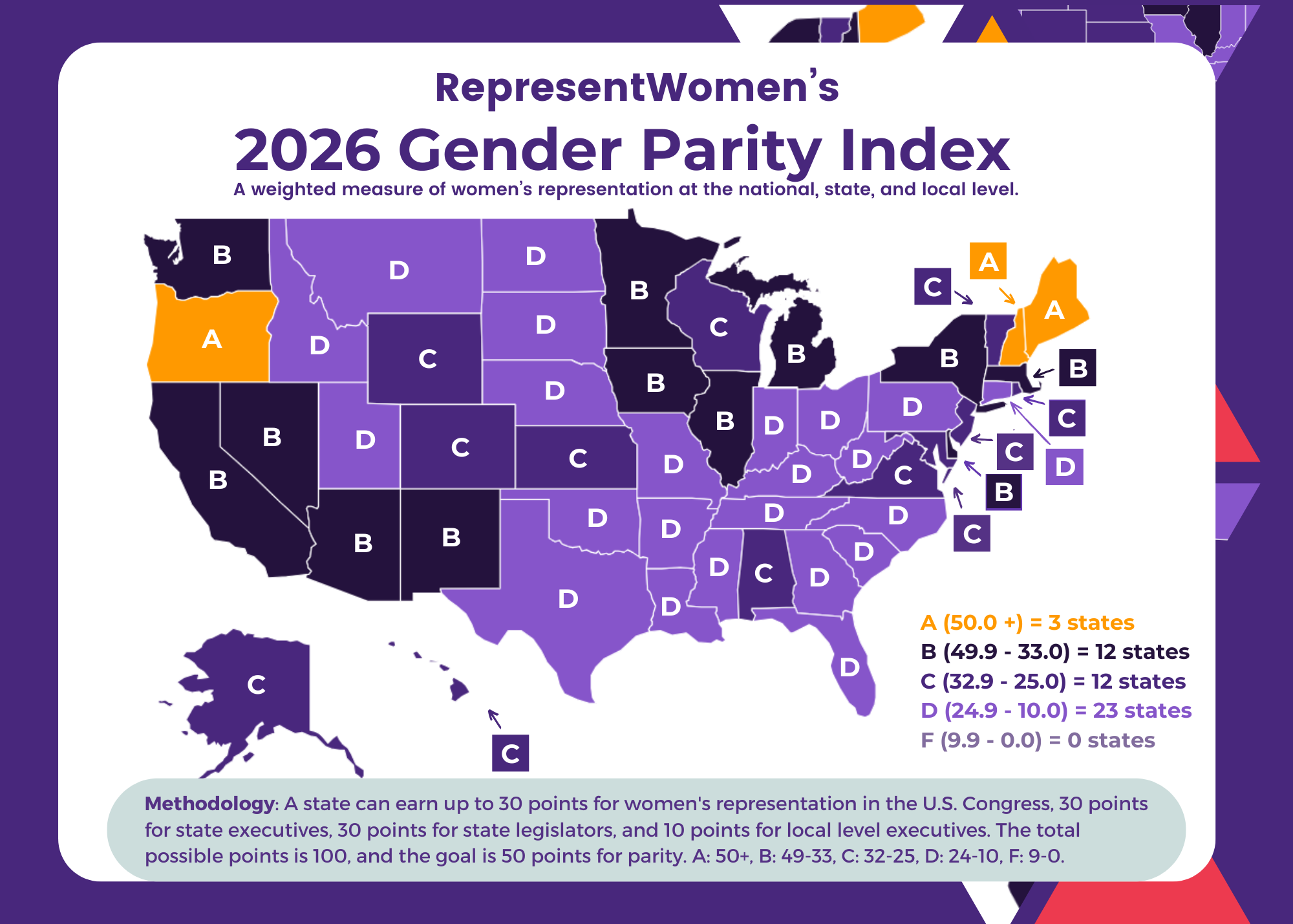
There is real news in this year's Index, and some of it is worth celebrating. For the second year running, three states, New Hampshire, Maine, and Oregon, have held onto an "A" grade, which means they've crossed the halfway mark toward full parity, and New Jersey and Virginia earned a "C" for the first time in the Index's thirteen-year history, largely on the strength of Mikie Sherrill's and Abigail Spanberger's wins for governor this past November. But that progress sits alongside a harder truth: 23 states are still stuck with a "D," and the national average comes to just 28.2 out of 100, which tells us that thirteen years into asking this question, we remain only barely past halfway to parity. Idaho, which used to rank respectably in the 30s, now ranks dead last. Washington has hovered on the edge of parity every single year since we started keeping score in 2013, close enough to see the finish line and still, somehow, never crossing it. Firsts happen, again and again, in a way that can make progress feel inevitable. The overall math tells us it never has been, and moves at its own, much slower pace regardless.
That is what the Gender Parity Index is for and why it is such a powerful tool. It is not a scoreboard we check once a year and set aside. It is the evidence we carried into every conversation at NCSL this week, so that the next milestone is not just another first to celebrate, but proof of a system finally built to let women stay.
An excerpt from Annis Cassells’ "That Moment When We Call the Roll."
Disenfranchised
and discounted,
women organized,
fought, forged ahead,
showed up.
Lucretia and Elizabeth crusaded
for abolition and women’s rights
Susan campaigned for suffrage
Alice led protests
Ida B. wrote (and marched, anyway)
Phoebe penned a letter
to a Tennessee state senator:
“Dear Son…Hurry and vote
For suffrage…be a good boy.”
And, red rose in his lapel,
he obeyed his mother,
cast the tiebreaker aker,
secured the right
to vote
for some women.
Milestones: Hillary Clinton becomes the first woman to secure a major party’s nomination for president in 2016.
Birthdays: Birthdays: Maya Rudolph, actress & feminist; Jackie Weiss, neuroscientist; Huma Abedin, former Hillary Clinton staffer; Lucy Burns, suffragist (1879); Liz Cheney, former U.S. Rep.; Jackie Kennedy Onassis, former First Lady; Ali Krieger, professional soccer player and activist; Annis Cassells, poet & author; Nicole Austin-Hillery, president & CEO Congressional Black Caucus Foundation, Sharon Creech, author; Dee Frankfourth, campaign consultant; Ann Greiner; Evelyn Haworth Nicholson, (1903-1994); Ellen Brodsky, filmmaker; Kaitlin Calogera, A Tour of Her Own; Anita Hill, professor & lawyer; Celeste Ng, author; Patricia Schroeder, first woman representative elected in Colorado; Eleanor Smeal, co-founder & president of the Feminist Majority; Brandy Brooks, community activist; Marjorie Clifton; Bea Shakow; Beatrice Medicine, Standing Rock Sioux member and anthropologist, Muriel Bowser, Mayor of D.C
Ask National Democrats to Reconsider Ranked Choice Voting Ban

It’s no secret for readers of my column that I believe the data is convincing that ranked choice voting (RCV) helps level the electoral playing field for women by weakening the control of gatekeepers and incentivizing more civil and collaborative campaigns. RCV has additional benefits too, such as its clear value for political parties to nominate more unifying candidates, as recently demonstrated in Maine’s Democratic gubernatorial primary won handily by Democrat Hannah Pingree after she trailed in first choices.
That’s why I was so enraged to learn that the Democratic National Committee’s Rules and Bylaws Committee (RBC) has voted to block state parties from making use of RCV to select a nominee in their 2028 presidential primaries – see this article about outraged Maine Democrats, with a recent University of New Hampshire poll finding that registered Democrats in Maine support their RCV law that includes presidential primaries by a margin of 84% to 6%. This Maine article unfortunately includes a falsehood from the Rules and Bylaws Committee co-chair Jim Roosevelt that RCV ballots are incompatible with party rules. That misstatement is puzzling, given that the DNC under Jim’s leadership has approved several uses of RCV in 2020 and 2024 that were consistent with those rules.
Driving the DNC’s proposed RCV ban is long-time RCV skeptic Frank Leone. Ironically, Frank lost the debate among Democrats in Arlington (VA) over use of RCV in all their nominating contests, where RCV has been overwhelmingly popular and passed into county law. He then moved to Washington, D.C., where 73% of voters in 2024 voted to implement RCV for all contests, including presidential primaries — with a great rollout of using RCV in this summer’s primaries. But if you can’t win locally, Frank’s approach is to impose bans nationally. Mirroring new language passed by the Republican National Committee (!!), his proposed rule would block D.C. Democrats from making use of RCV in their 2028 primary, despite the D.C. law being intentionally constructed to be consistent with his party’s rules on proportional allocation of delegates.
My husband Rob Richie recently explained in The Expand Democracy 3 the value of RCV in presidential primaries for both parties — with Republicans having a compelling case to turn to RCV as well. Involving Democrats and their proportional allocation rule, Rob writes:
Democrats have a strict requirement for proportional representation across all states, with statewide delegates allocated to any candidate earning at least 15%. That makes winner-take-all forms of RCV a non-starter with Democrats. But 15% is a high number, and millions of votes are “ineffective” because they are below the threshold. Embracing a caucus-like “realignment” rule with ranked ballots would allow those voters to get a chance to have their vote count. That is, you would count all first choices, then, in the realignment round, move all ballots cast for nonviable candidates below the 15% threshold to their next-ranked viable choice. In 2020, about 90% of such voters in the four states providing data about how voters used their ranked ballots had their ballots count toward viable candidates. Translated across all states, that would be a huge win for voting rights and likely result in more votes making a difference than any other reform…
For Democrats, this is a key cycle for their commitment to voting rights. FairVote’s polling shows a remarkably broad and high level of support for RCV among Democratic voters, including a margin of greater than 10 to 1 for its voters under 50. Democrats also have a great lesson from 2020 showing that RCV work, which is why many of their state party leaders want to use RCV in 2028. With numerous state parties that run their own contests wanting to do vote-by-mail with RCV, national Democrats would do well to get out of their way and simply spell out clearly the acceptable rules for using RCV to make more votes count.
The proposed ban of RCV will only become finalized in mid-August at the next meeting of the full DNC. A number of state party leaders gearing up to use RCV in 2028 contests are encouraging people to talk with any DNC members they might know to ask them to withdraw this rule. Ideally, the RBC would be directed to provide guardrails to define how they want state parties to make use of RCV ballots rather than impose a draconian ban that is deeply unpopular among Democratic voters – and bad for a party seeking to uphold voting rights and identify a unifying nominee in 2028.
To find out more about how you can help, please visit FairVote Action's website page for more information on how to get involved.
Good Ranked Choice Voting News Abounds

Even if national Democrats do choose to vote to ban RCV in presidential primaries, I am confident that ban won’t last another cycle — see the momentum for RCV continuing to build where it becomes the norm across all states. Let me share a round of news:
Honolulu, Irvine (CA), and Longmont (CO) will vote on RCV in November: RCV has won majorities from voters in more than 30 straight city ballot measures. FairVote CEO Meredith Sumpter released a short video on three more localities voting on RCV, and here's more from FairVote:
Since July 14, city officials in Honolulu HI, Irvine, CA; and Longmont, CO all voted to put ranked choice voting (RCV) on the ballot this November. Honolulu is Hawaii’s capital, and home to nearly 70% of the state’s population. Irvine is home to over 300,000 people, and Longmont is one of the fastest-growing cities in America. Together, these cities are home to 1.4 million people, who could soon have better elections with ranked choice voting.
Huntington Beach voting rights case results in RCV: Huntington Beach (CA) is a city of nearly 200,000 people with winner-take-all, at-large elections that make it nearly impossible for racial and ethnic minorities protected under the California Voting Rights Act from being able to elect candidates of choice. With the support of the plaintiffs challenging the city’s exclusionary voting system under the CVRA, a state judge has ordered Huntington Beach to implement a proportional form of ranked choice voting. Here’s more from LAist:
Judge Griffin wrote that ordering the city to adopt ranked-choice voting was a “less drastic remedy” to bolster Latinos’ voting power than district elections. Currently in Huntington Beach, all residents vote citywide for city council seats, and the top vote-getters win.
With district elections, only people within a particular district can vote for a particular seat, which advocates say helps ensure districts see themselves represented in their local government bodies. Among the advantages of a ranked-choice system, advocates say, is that it gives voters more freedom to vote for their favorite candidate, even if they think that person won’t ultimately win.
New scholarship finds proportional RCV a promising voting rights remedy: Harvard law professor Nicholas Stephanopoulos lifted up on the Election Law blog an important new academic paper. Here’s his post:
Michael Hankinson, Joseph Loffredo, and Asya Magazinnik posted this interesting new paper showing that alternative remedies like ranked-choice voting are systematically more effective than single-member districts in remedying violations of the California Voting Rights Act. Here’s the abstract:
“As federal voting rights protections recede, state-level voting rights acts (VRAs) have become the principal legal tool for safeguarding minority representation in the United States. We assess what these laws can accomplish using the California Voting Rights Act, which has compelled over 150 cities to replace at-large with district elections. Applying redistricting algorithms across 109 cities, we evaluate how much district elections-and the alternative reforms state VRAs permit-can amplify Latino political influence. District elections prove to be a limited remedy: most cities cannot draw a majority-Latino district and many cannot use districts to meaningfully increase Latino electoral success, even under optimistic assumptions about turnout, cohesion, and crossover voting. By contrast, cumulative voting, ranked choice voting, and limited voting empower Latino voters without relying on favorable geography or mapmakers’ discretion. We conclude that policymakers seeking to improve minority representation should be more open to reforms within the proportional representation family.”
Alaska’s top 4 primary with RCV produces governance for voters: RepresentWomen has been pleased to hold several events with Alaska leaders like state Senator Cathy Geisel on their state’s powerful combination of all-candidate primaries with RCV in November. This week Cathy co-authored an Anchorage Daily News article on “We govern across the aisle. Alaska’s open primary makes it possible.” Here's an excerpt:
We’ve seen the benefits in recent years. Cross-partisan majorities have brought legislators from across the aisle together to tackle some of the state’s most difficult challenges. We have not voted the same way on every bill, and we never will. But we have demonstrated that disagreement does not have to lead to paralysis. When legislators are encouraged to represent the full breadth of their communities instead of the narrowest slice of partisan opinion, they can find durable solutions. That is true public service.
New British minister Andy Burnham's lived experience with RCV — and his mayoral replacement being picked this week with it: In the United Kingdom, several English cities like London directly elect their mayors. They are elected with the simplified "supplementary vote" form of RCV being used this week to fill Greater Birmingham's mayoral vacancy created by Andy Burnham becoming the new British prime minister. Watch Burnham explaining how revelatory it was for him to run and win in this system. (Note that if Burnham had had challenges for leadership of the Labor Party this summer, that party would have used RCV, just as done by all five national parties in Canada.
Local dialogue about RCV in Albany (NY) & Deschutes County (OR): My husband Rob this month had two excellent chances to support local energy for RCV, which is emblematic of local energy around the U.S. RCV Albany has made great headway toward New York’s capital city; Rob had an op-ed in the Albany Times-Union making the case. And during his trip to Bend in Deschutes County (OR), the local League of Women Voters gave a lecture that drew well over 100 people to learn about a campaign to bring proportional RCV to Deschutes.
Women in Power: New Book on Fighting for Democracy
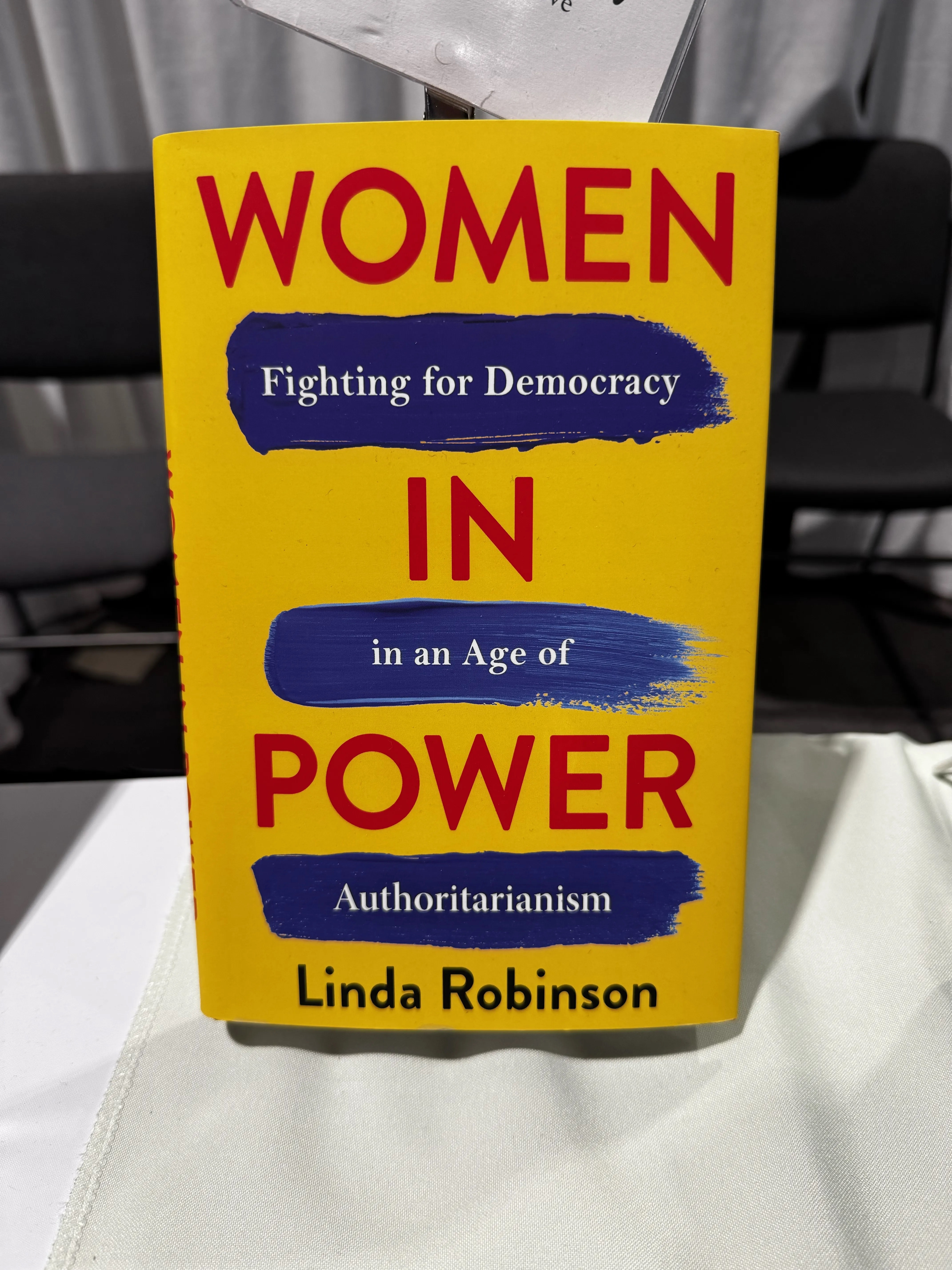
I was glad to be at a wedding in Vermont for a long-time family friend, but it did mean I had to miss a presentation at Politics and Prose in Washington, D.C. by the Council on Foreign Relations’ Linda Robinson on her new book Women in Power: Fighting for Democracy in an Age of Authoritarianism. I’m deeply interested in this theme and look forward to diving into the book, which includes a call for the kind of structural reforms RepresentWomen studies and supports. Here’s more from the Politics and Prose announcement of Linda’s talk with Tamara Wittes, and here's a link to the video of their conversation:
Around the world, antidemocratic forces are taking aim at women leaders. Misogynistic authoritarianism has entered the mainstream, seeking to reverse decades of progress. Weaponized digital technologies have unleashed sexualized smears and violent threats. There is a deep connection between attacks on women and attacks on democracy—and female leaders can show us how to fight back.
Linda Robinson—an award-winning journalist and foreign policy expert—tells the powerful stories of the women on the frontlines of the battle between democracy and authoritarianism. Despite age-old obstacles and virulent new dangers, these remarkable leaders have strengthened their countries, expanded gender equality, and promoted policies that benefit all. Tsai Ing-wen crafted a strategy to defend Taiwan from Chinese aggression while advancing social reforms. Estonia's Kaja Kallas and Moldova's Maia Sandu fought Russian hybrid warfare by pursuing European integration. Balkan leaders Vjosa Osmani and Natasa Pirc Musar bolstered their democracies against Serbian and Russian destabilization. Mia Amor Mottley of Barbados became a global champion for climate justice, rising above sexist attacks to achieve international financial reforms. Robinson distills the hard-won lessons of these and other recent leaders—including New Zealand's Jacinda Ardern, Finland's Sanna Marin, and Sigrid Kaag of the Netherlands—providing a roadmap for countries facing existential threats. Timely and vivid, this book spotlights women's leadership amid the global crisis of democracy.
I was honored to be invited to join Linda Robinson, a fellow Swarthmore College graduate, for an in-person DC roundtable, Advancing Women's Political Representation and Democracy, last June. Our conversation connected directly to a chapter in her book, Women and Democracy, where she writes:
"Electoral reforms, such a multi-member districts with proportional representation and ranked choice voting, provide for a wider spectrum of political views and representation. The U.S. system of single-member districts and winner-take-all voting, together with gerrymandering, fosters the kind of partisan minority dominance so common today."
In Memoriam: CAWP Co-Founder Ida Schmertz Dies

The New York Times this week featured an obituary about Ida Schmertz, co-founder with Ruth Mandel of the Center for American Women and Politics at Rutgers. I’m always so appreciative of the women who have done so much to advance an understanding and appreciation of the changes we have made and must continue to make to secure women’s equality. Along with this obituary, you might want to watch a great video conversation between Schmertz and Mandel:
"Ida Schmertz, an influential behind-the-scenes feminist and corporate executive who was a founding director of the first academic research center devoted to American women and politics, and who helped women advance in workplaces as varied as the dockyard and the C-suite, died on July 2 in Manhattan. She was 91….
Ms. Schmertz, who described herself as “a feminist before I knew the word,” had worked in Democratic politics and on gun control issues when she got a tip from a Rutgers University dean about the formation of a new research unit on campus: the Center for American Women and Politics at the Eagleton Institute of Politics. Along with Ruth Mandel, an English professor at Rutgers, she became, in 1971, a founding director of the center, widely considered the premier research and educational institution in the country for the study of women in politics…
Donald Herzberg, then the head of the Eagleton Institute, took a risk in supporting the creation of the center, Ms. Schmertz and Dr. Mandel said, at a time when many academics, including some at Rutgers, didn’t see the need to explore the topic. The subject “of women and politics — it did not exist,” Ms. Schmertz said in 2014 in a video interview with Dr. Mandel about the center’s creation. “It did not exist in political science.”
In 1972, Ms. Schmertz and Dr. Mandel organized the first national conference for female state legislators.
“They really captured a moment when electoral politics and the women’s movement met,” Debbie Walsh, the center’s current director, said in an interview. “It was about, ‘How do we change the face of political power so that women are speaking in their own voices inside these male-dominated institutions?’”
That's all for this week!
.png)