Today, voters in two states, the nation’s capital and more than a dozen cities and counties will cast ranked choice ballots. Voters in three more cities will decide whether to adopt ranked choice voting, and Alaskans will decide, for the second time in two years, whether to keep it.
At RepresentWomen, we’re watching these races closely because ranked choice voting is the pro-democracy, pro-women, and pro-voter reform that fits American government as it is structured today. It works across all of the 520,000 elected offices in the country, most of them local and nonpartisan. And where it’s used, women are better represented. Women hold 55 percent of city council seats in cities that use ranked choice voting, significantly higher than cities that don’t. See the evidence on our new ranked choice voting page.
Here are the races we’re watching most closely.
Alaska: A more representative system on the ballot
Alaska pairs a top-four open primary with ranked choice voting general elections for every state and federal office, including this year’s closely watched U.S. Senate race. Today, Alaskans are also voting on Ballot Measure 2, which would repeal the state’s top-four primary and ranked choice general elections. A nearly identical repeal failed in 2024, by 737 votes, the narrowest ballot measure result in state history.
Since the state’s first use of RCV in 2022, women’s representation in the Alaska Legislature has reached new highs. Women now hold 25 of 60 seats, the most in at least two decades, and voters elected the state’s first majority-women state House. For the first time, the legislature also includes nonpartisan women, Reps. Alyse Galvin and Rebecca Himschoot, both elected in 2022. And both chambers have been led by cross-partisan coalitions, with legislators working across party lines to govern.
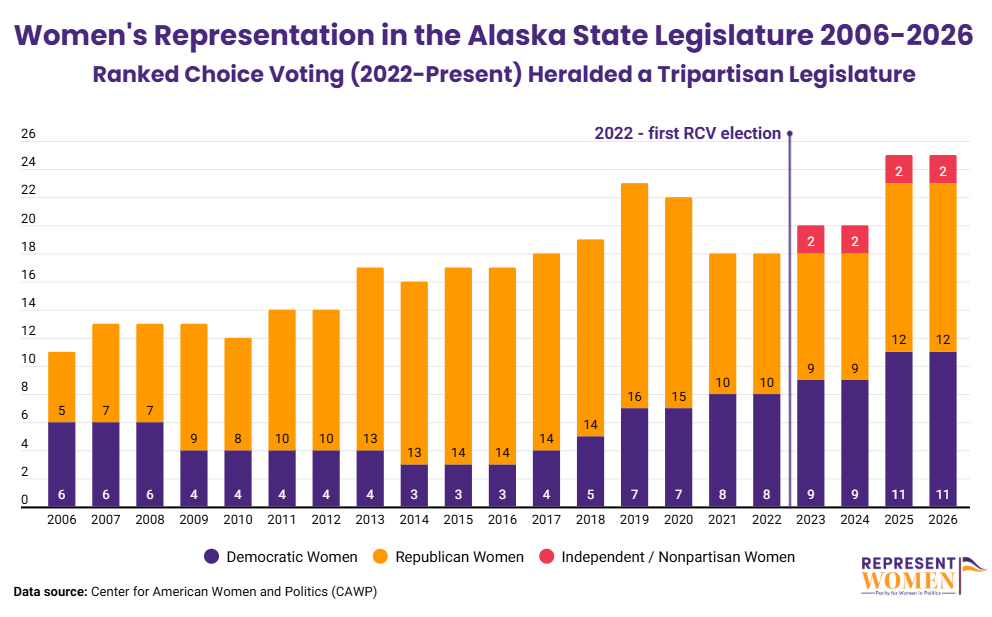
Alaska is also one of only eight states where Republican women hold at least a third of their party’s state legislative seats. And women are on the ballot at the top of the ticket this year: if Mary Peltola wins her Senate race, Alaska would send two women to the U.S. Senate for the first time.
Maine: Ranked Ballots for Congress
Maine, the first state to use ranked choice voting statewide, has used ranked ballots for primaries and federal elections since 2018. Today, Maine voters will rank their choices for the U.S. Senate and House races, including one of the most competitive and expensive Senate contests in the country.
Ranked choice voting also shaped Maine’s race for governor this year. In June’s crowded Democratic primary, Hannah Pingree trailed after the first count. Once the ranked choice rounds were tallied, she won the nomination with 56 percent of the final-round vote, a majority of voters who ranked a finalist. Ranked choice voting allows voters back their favorite candidate without worrying about splitting the vote, and the nominee earned majority support. If Pingree wins today, Maine would elect a woman as governor for the third election in a row.
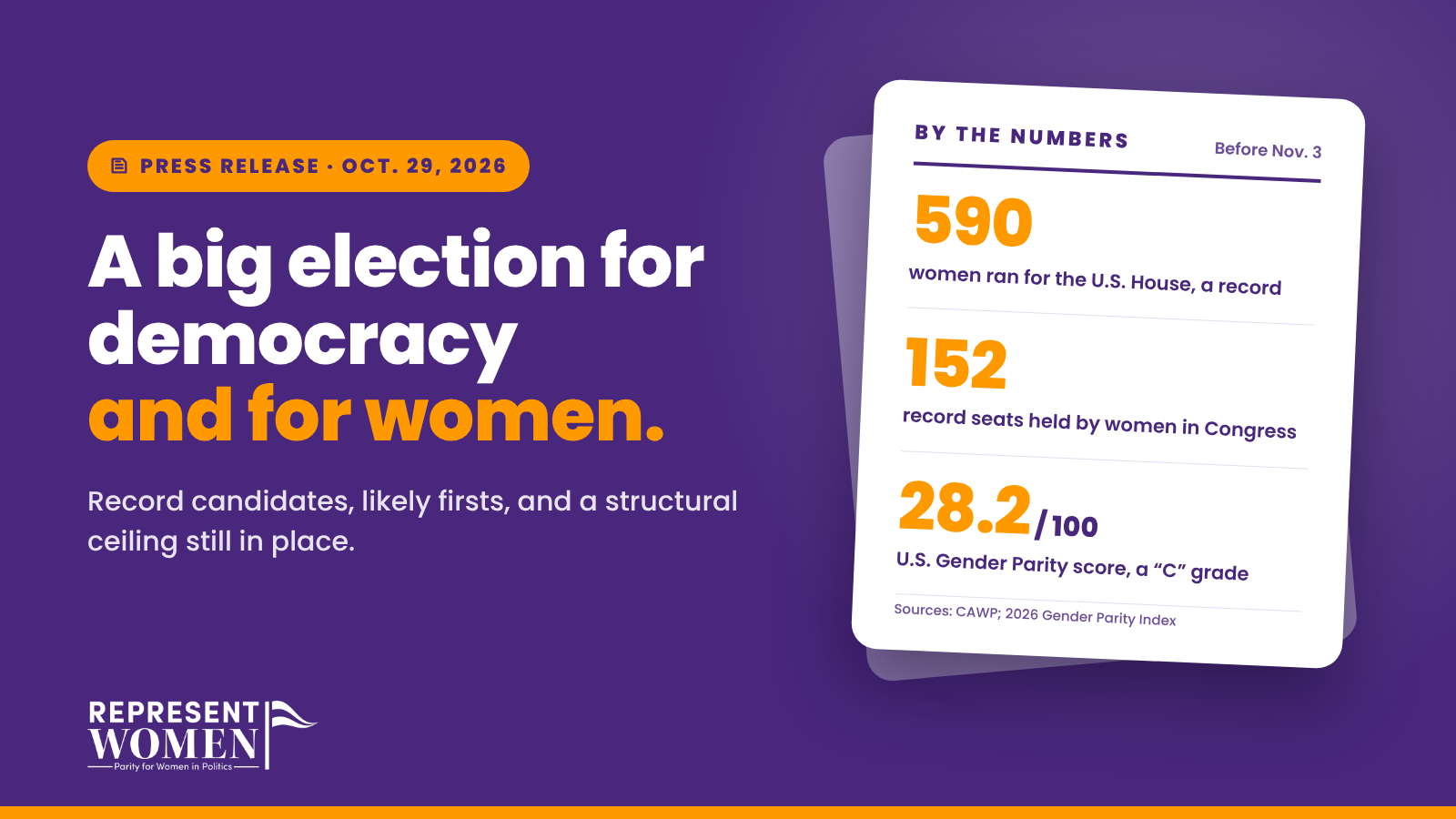
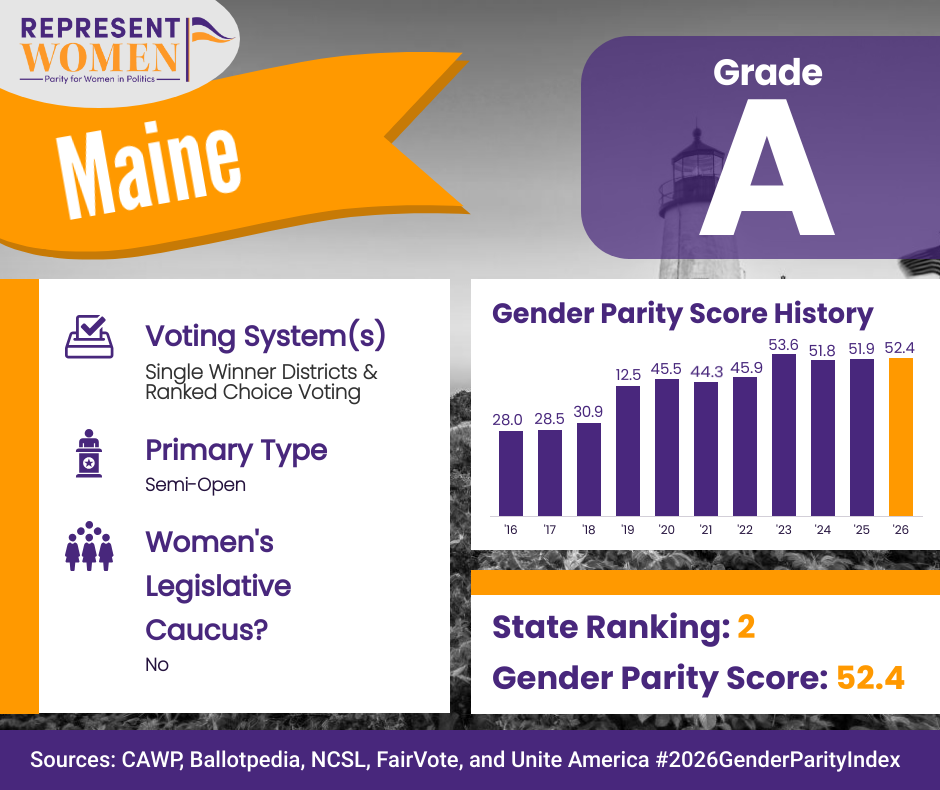
That sustained progress shows up in our data. Maine ranks second in the nation in our 2026 Gender Parity Index, with a score of 52 out of 100, and is one of only three states to earn an “A.” It is also one of the few states where women's representation has stayed strong across levels of government, not just a single standout race.
Portland, Oregon: A test of proportional RCV and incumbency
Portland is holding its second election under proportional ranked choice voting, in which each district elects three council members. Districts 3 and 4 are up this year, and all six incumbents, including three women, are running for reelection. Twenty-one candidates are competing for three seats in District 3, and 12 candidates for three seats in District 4, according to Rose City Reform.
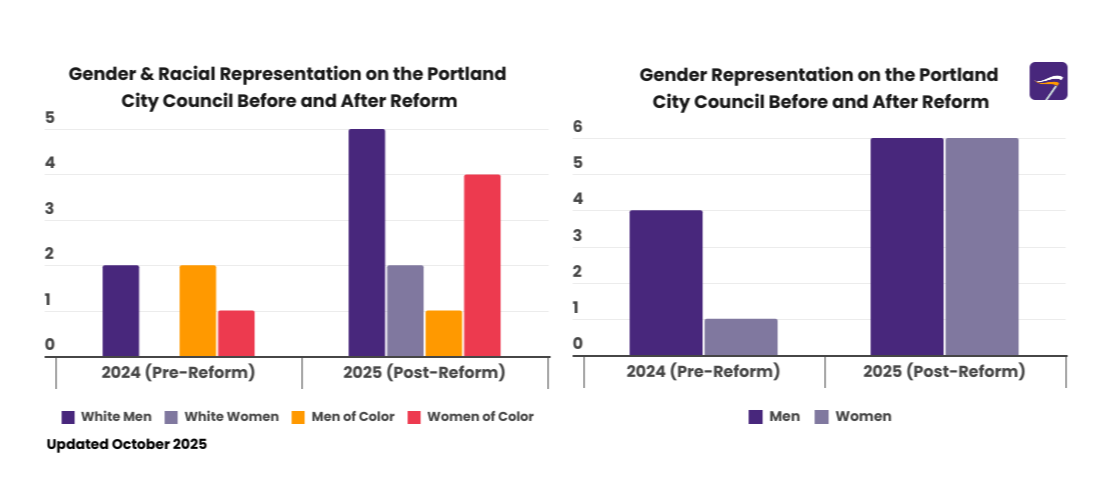
That makes Portland a real-world test of a question at the heart of women’s representation: what happens to results for women when more candidates can run and win from the same race? Our Parity in Portland report found that the city’s first proportional election produced a more representative council, and we’ll be watching whether that holds.
Longmont, Colorado: A vote on proportional RCV
Longmont voters will decide on two companion measures today. Ballot Question 3C would bring ranked choice voting to city elections, which would ensure winners earn majority support. Question 3D would change the election calendar so that all of the city's at-large council seats are elected at the same time, instead of alternating years, which would make these seats eligible for the proportional form of ranked choice voting.
Together, the two measures would bring both forms of ranked choice voting to Longmont. Races for a single seat would use ranked choice voting so that each winner earns majority support. And with the at-large seats on the ballot together, those races could use proportional ranked choice voting where more than one candidate can win from the same election. That means gains for women can build on one another instead of simply trading places.
Longmont Mayor Susie Hidalgo-Fahring, the first Latina mayor in the city’s history, has endorsed both measures, stating:
“I support ranked-choice voting because it gives voters more meaningful choices and allows them to vote on the candidate they truly favor. RCV encourages candidates to reach beyond their core supporters to build broader coalitions and listen to more of the community. I believe our elections should encourage thoughtful participation, representative outcomes, and a stronger connection between voters and the people who serve them.”
Support has also come from other elected officials, including Longmont State Senator Katie Wallace, who stated the following in support of the reform:
“I work every day to protect electoral integrity as Chair of the Senate State Affairs Committee, and I believe our democracy is strongest when every voter has a meaningful voice. Longmont’s ranked choice voting measures offer our community the opportunity to rank candidates in order of preference, rather than feeling forced to choose just one. It is a commonsense step toward making our local elections more representative of the people they serve. I’m proud to support giving Longmont voters a stronger voice and a better way to make their choices count.”
RepresentWomen has been a proud partner of in-state ranked choice voting educational organizations, including Courageous Colorado, as our research shows that single winner and proportional ranked choice voting benefits women and candidates of color.
Honolulu, Hawaii: One election, a majority winner
In Honolulu, voters will decide on Question 5, which would bring ranked choice voting to elections for mayor, prosecuting attorney and all nine City Council seats.
Today, Honolulu’s nonpartisan city races start in August. If no candidate wins a majority, the top two go to a runoff in November. Ranked choice voting would let voters reach a majority without a separate runoff contest. Under Question 5, most contested races would be decided in a single November election, when turnout is far higher: across 2016 to 2024, turnout averaged about 40 percent of registered voters in August and 58 percent in November, according to the University of Hawaii Economic Research Organization.
Under this new system, voters could rank up to five candidates, and the measure has broad support according to FairVote, including from the League of Women Voters of Hawaii, the Honolulu Star-Advertiser editorial board, and former state Rep. Beth Fukumoto.
“Ranked choice voting would improve Hawaii’s elections by increasing competition, strengthening representation and encouraging voter participation. – Beth Fukumoto, former state representative
Irvine, California: Voters weigh in on Measure D for RCV
In Irvine, Measure D would bring ranked choice voting to elections for mayor and City Council beginning in 2028. Voters could rank up to five candidates, and a candidate would need a true majority to win. Supporters at Voter Choice Irvine argue that it would reward majority support, encourage more civil, issue-focused campaigns and let voters back every candidate they link without worrying about wasting their vote.
The effort to bring ranked choice voting to Irvine has drawn a broad coalition, including the League of Women Voters, Veterans for All Voters, the UC Irvine Faculty Association, local labor unions, and RepresentWomen.
Every ranked choice election on today’s ballot
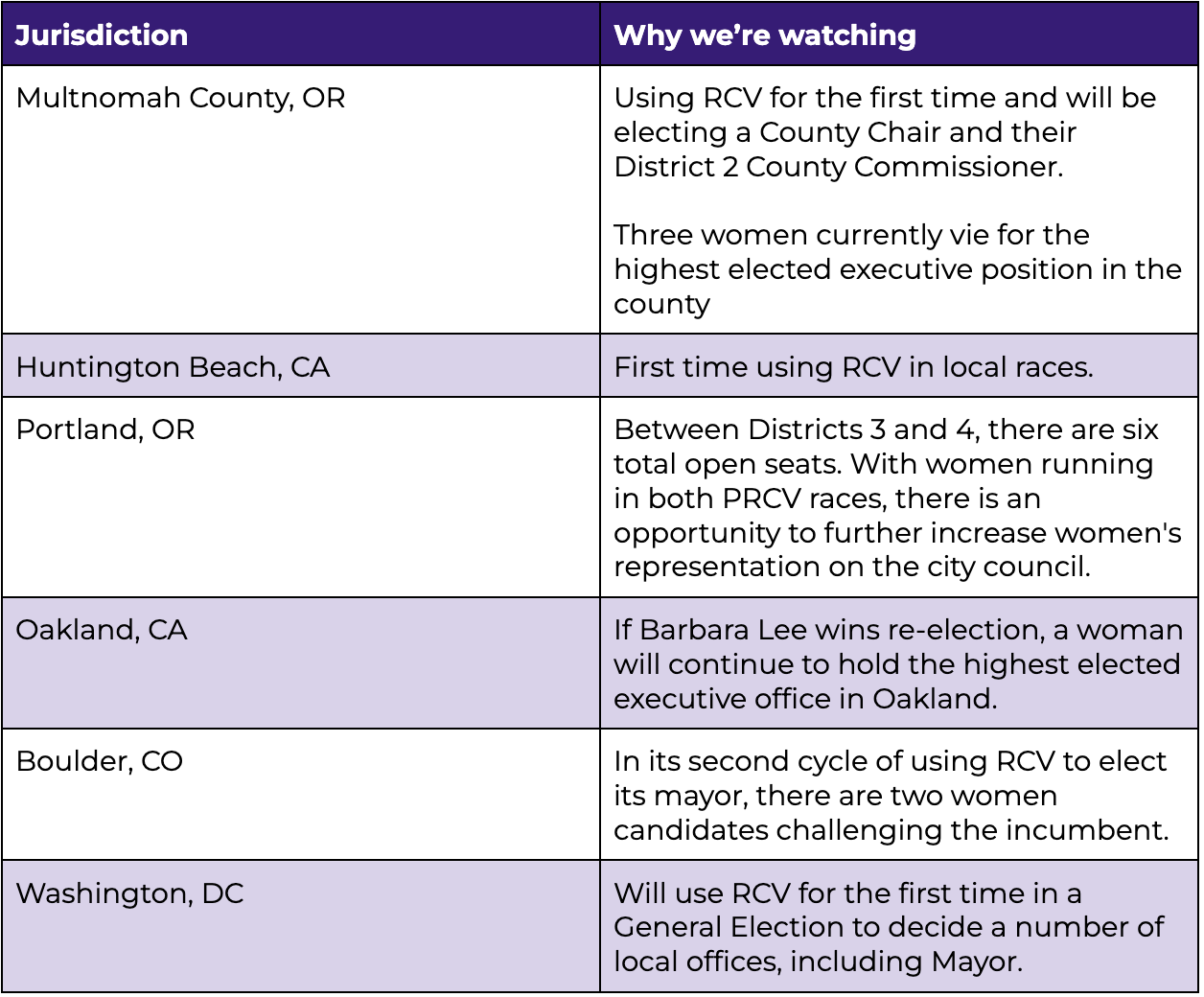
Beyond these headline races, voters in more than a dozen cities and counties are ranking their choices today, from San Francisco's Board of Supervisors to Arlington County’s board in Virginia, all of which FairVote is tracking today. The races we are looking at closely for women include the following:
Why ranked choice voting matters for women
When elections are winner-take-all and decided by a small percentage of voters, women too often face pressure not to “split the vote” and doubts about “electability".” Ranked choice voting eases both. Winners need majority support, so more candidates can run without being labeled spoilers, and voters can rank the candidates they actually prefer.
The results show up where it’s used. Women hold 55 percent of city council seats and 36 percent of mayors’ offices in cities that use ranked choice voting. In New York City, women hold 32 of 51 City Council seats, up from 13 before the city adopted ranked choice voting. And in Alaska’s first ranked choice election for the U.S. in the Senate in 2022, three of the four finalists were women.
Try ranked choice voting yourself
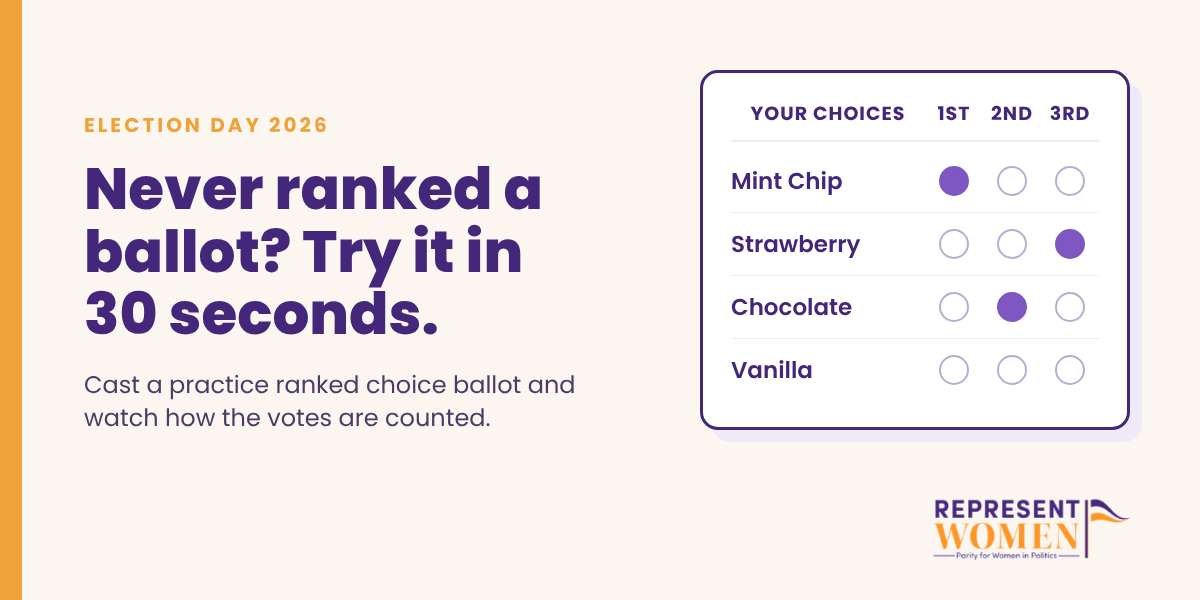
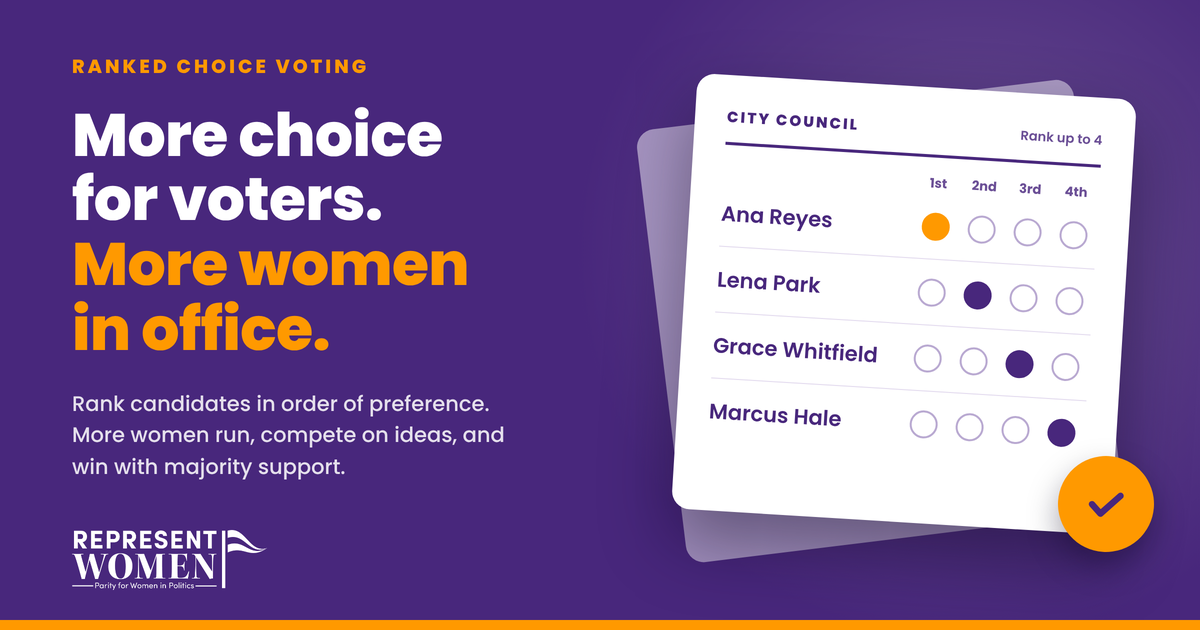
Ranking your choices is as easy as 1-2-3, and voters agree: in a 2022 exit poll, 79 percent of Alaska voters said ranked choice voting was simple. Want to see for yourself? Cast a practice ranked choice voting ballot at RCV123. You can rank your favorite ice cream flavors, or try a ballot modeled on the ones Alaska and New York City voters use, and watch how the votes are counted. Try RCV now!
A final reminder: Have patience on the count
Some of today’s ranked choice races will be called tonight. Others won’t be, and that’s normal. Counting the votes in a ranked choice voting election takes just as much time as counting them in any other election, according to the RCV Resource Center. The biggest factor in how soon we know a winner is how close the race is. In races that aren’t tightly contested, winners will be clear quickly. In very close races, we may not know until every ballot is counted.
As the RCV Resource Center notes, the real bottleneck, in any election, is scanning in every ballot. Most election offices don’t finish counting all ballots until days after Election Day, whether or not they use ranked choice voting. Some run the round-by-round ranked choice count on election night as results come in; others wait until every ballot is in.
Alaska is a good example. The state accepts absentee ballots that arrive up to 15 days after Election Day, because many voters live in communities reachable only by plane or boat, and state law does not allow these ballots to be counted early. That timeline long predates ranked choice voting: before Alaska adopted its current system, the U.S. Senate winners in 2008 and 2010 weren’t known until the end of the 15-day window, according to FairVote. Once every eligible ballot is in, Alaska runs its ranked choice tabulation, scheduled this year for November 18, and each race takes about a minute.
A count that takes time is a count that gets it right. And when it’s done, the winner will have earned majority support.
We’ll be tracking these races tonight and in the days ahead. Follow along on our Election Scorecard, and learn more about how ranked choice voting works for women.