It’s Not Just Who You Vote For — It’s How
What I learned about ranked choice voting and why it matters for women’s representation in the U.S.
By Livia Follet, RepresentWomen Communications Fellow

This article was originally posted to RepresentWomen's Substack.
When most people think about voting, they think about campaigns, candidates — who they are going to vote for. But what about how we vote?
That wasn’t a question I’d thoroughly considered until recently, when I began working as a Communications Fellow at RepresentWomen and started diving into the structures of our election systems and learning about how these structures impact outcomes, especially for women.
Even as someone who was raised by a strong group of democracy defenders, I still had so much to learn. If you’re like me and hadn’t thought deeply about how a voting system’s structure affects representation, you might be surprised to learn that how we elect our leaders is just as important as who gets on the ballot in the first place. The research aligned with my lived experience as a journalist and a voter; it helped explain why so many people I talk to say they feel like their voices aren’t heard.
I’ll do my best to walk you through how our voting systems could be different, because I think it’s worth understanding.
Many voting systems in the United States use a winner-take-all system where one candidate wins (often without a true majority of voter support) and all the rest lose. As people win without majority support, many voters don’t feel like their voices are heard. When voters don’t feel empowered, the health of our democracy suffers. Under the current system, it becomes difficult to achieve the goal of a truly representative democracy, one that looks like the people it represents.
Even though women make up 51% of the U.S. population, women account for just 28% of Congress today, a number that once steadily growing has plateaued. Despite milestones, women fill the same share of seats at every level of government as they did a year ago. Women make up 34% of state legislators and just 24% of governors. These numbers, while unsettling, are not unchangeable.
Voting systems are meant to be malleable — they are supposed to reflect the growing body of people they represent. Through innovative policy solutions, we can build the democracy we dream of. Ranked choice voting (RCV) has proven to be one of the many viable solutions to this issue, according to data from RepresentWomen’s research team. Jurisdictions with RCV in place see broader, more reflective electorates that have been chosen by a true majority of voters.
How Ranked Choice Voting (RCV) Increases Women’s Representation
At RepresentWomen, we track how women fare in RCV races in order to better understand how women stand to gain political power through democracy reform. While women’s representation has made improvements over the years, gains haven’t been consistent or durable with women still holding less than 29 percent of Congressional seats. Our RCV research shows us that gender parity is not only possible, but can be created in a sustainable way.
In cities that have adopted RCV, women hold 55% of city council seats, compared to 43% in non-RCV cities. On top of the accessibility that a ranked ballot provides, cities that adopt proportional ranked choice voting (PRCV) see elected leadership that better reflects the community it represents. Reforms also aren’t entirely effective all on their own; they work best when paired with candidate support and coalition engagement from communities on the ground. When education and training is paired with systems change, communities are not only more informed, but see increased chances of success when it comes to electing more women.
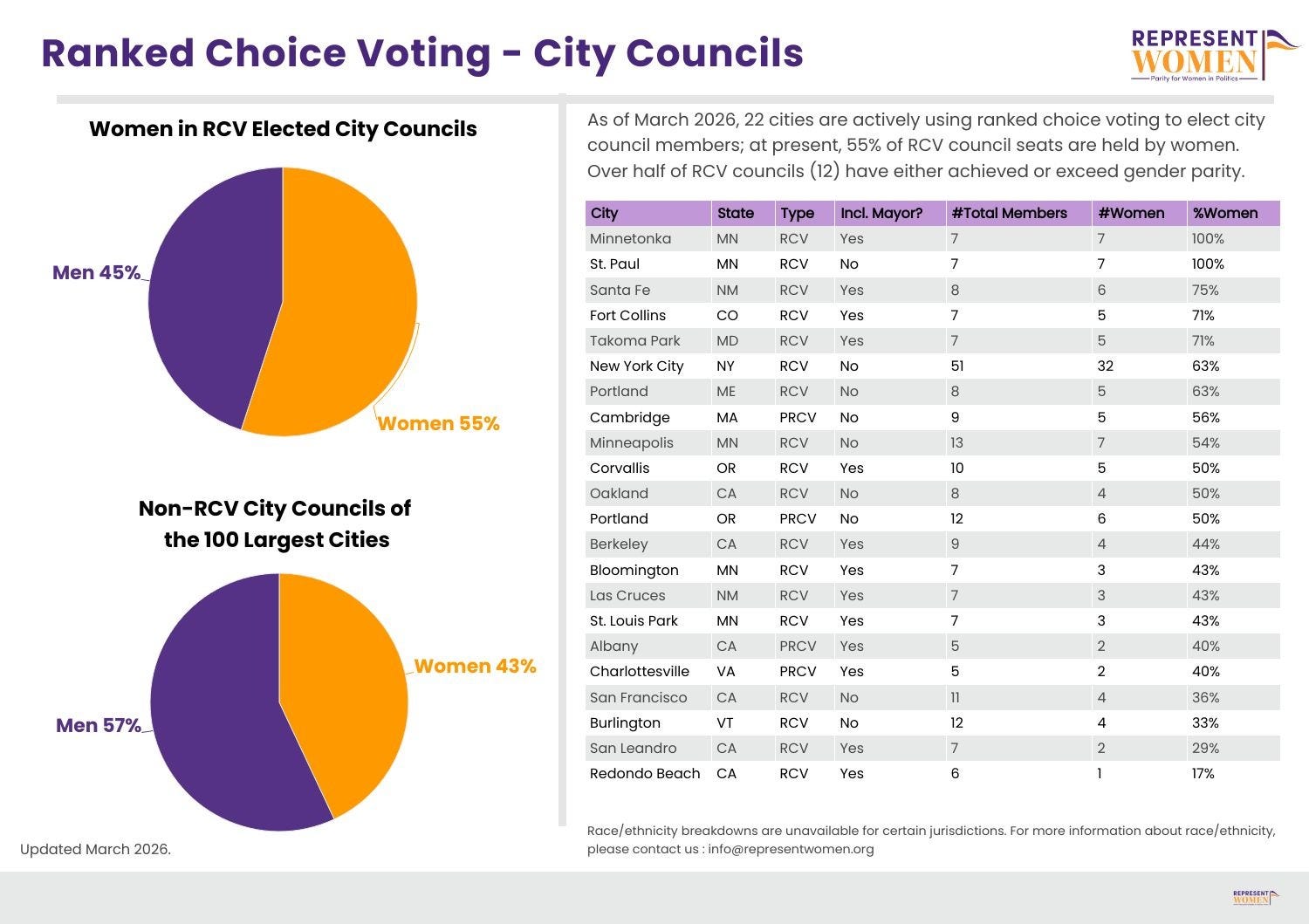
Two cities that stuck out to me were Cambridge, Mass. and Portland, Ore. — both have used proportional ranked choice voting (PRCV) to build city governments that actually look like the people living there. Portland’s story deserves its own space, so I’m saving it for a separate explainer on proportional representation that’s coming soon. Cambridge, though, tells a historically-rooted story of how RCV can shape democracy — it’s one of the case studies below.
Because here’s what actually convinced me RCV isn’t just a nice idea on paper: I didn’t have to look overseas for proof it works. It’s happening in cities, and a few states, right here in the U.S., and once I started reading through the research myself, the pattern was hard to miss. Four places made this click for me: Cambridge, Mass.; the California Bay Area; New York City; and a ranked choice voting pilot program in Utah. Each one shows something a little different about how RCV changes the odds for women, so I want to walk through them one at a time.
Four Case Studies that Convinced Me RCV Benefits Women
Cambridge, Mass. — 2026
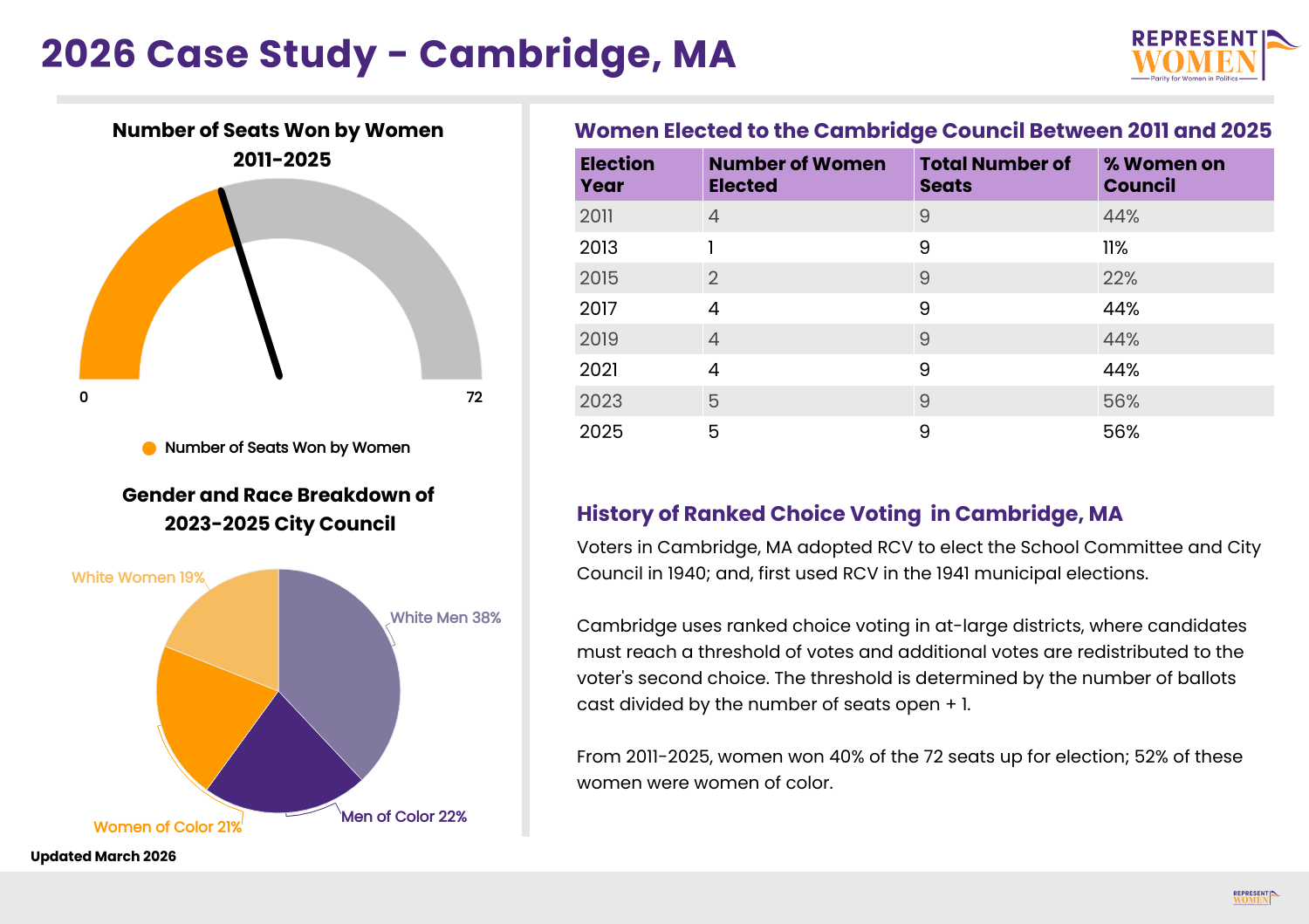
Voters in Cambridge, Mass. started using RCV in 1941 in at-large districts. From 2011 to 2025, women 40% of the 72 seats up for election. Over half of these women were women of color. The decades-long history of RCV in Cambridge shows that voting systems change can be sustainable and strengthen diverse representation over numerous election cycles.
California Bay Area — 2022
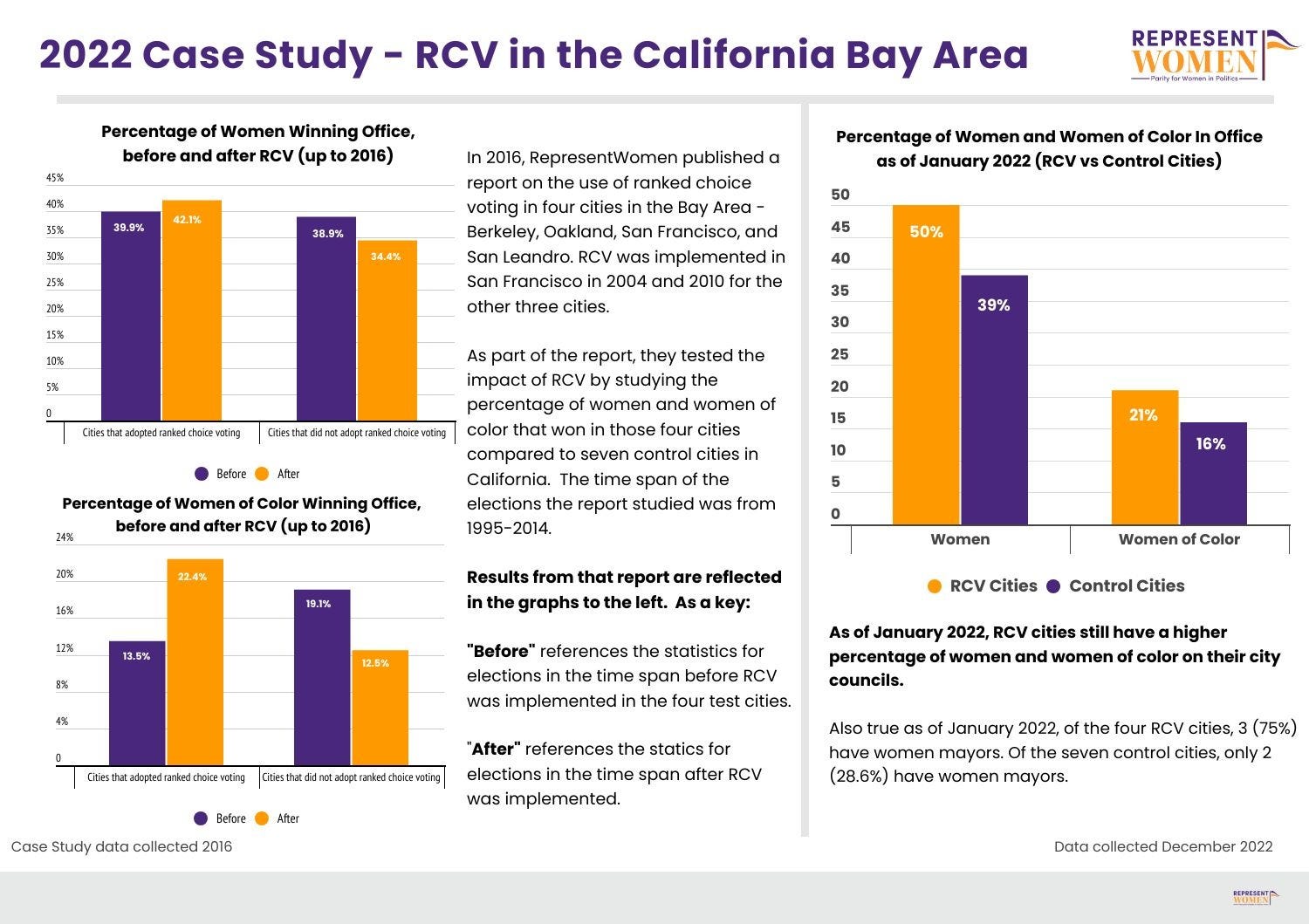
RepresentWomen’s report on Berkeley, Oakland, San Francisco, and San Leandro—all cities that implemented RCV over 15 years ago—have seen increases in the percentage of women running for office and winning their elections. As of March 2026, half of these cities have women mayors and, when combined, women make up 55% of their city councils.
New York City — 2022
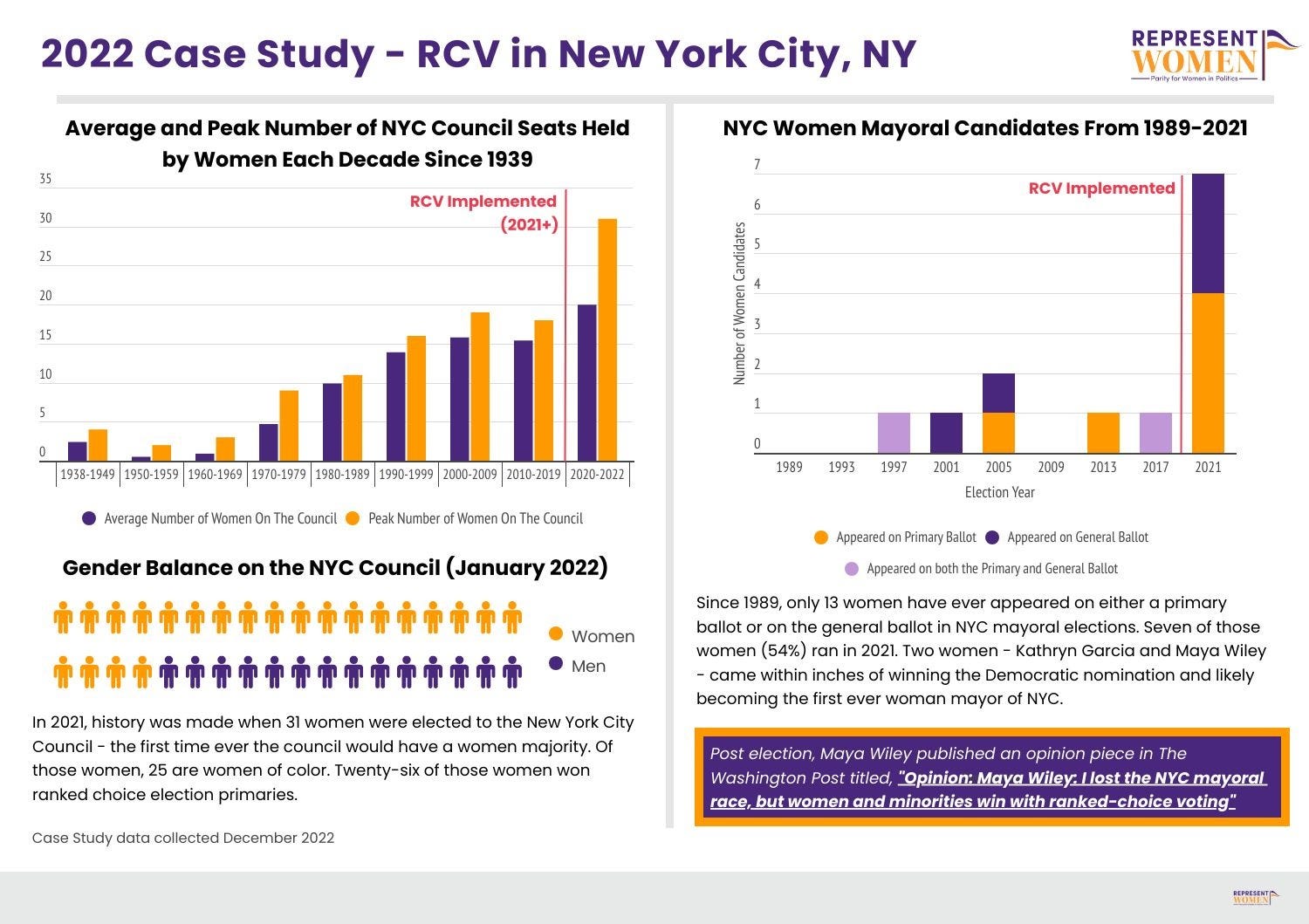
New York City implemented RCV in 2021 and the number of city council seats held by women skyrocketed from 18 to 31, making women the majority on the city’s council for the first time. The city has never held a woman mayor and only 13 women have ever appeared on a primary or general election ballot. However, seven of those women, or 54%, ran in 2021 after RCV was implemented. Today, women hold 61% of seats on the City Council.
Last year, I was lucky enough to participate in RCV for the first time in New York. I live in Astoria, and as I walked to the polls with my friends, I felt as though my voice was going to be heard through my vote for the first time. I was so excited to engage in a system that promotes women. But, I had more to learn when it came to understanding how New York City’s system in particular has been so effective.
I want to quickly add here that while RCV was a large factor in this increase, this singular reform alone doesn’t explain that leap. In 2017, a group of city council members founded 21 in ‘21 with a concrete goal: elect 21 women to the 51-seat council by 2021. Rather than waiting for the new voting system to do the work on its own, the group spent years recruiting and training women candidates and running voter education campaigns to help New Yorkers navigate a ranked ballot many were using for the first time in decades. RCV also arrived alongside an expanded small dollar public financing program and a wave of open seats from term limits, which lowered the cost and difficulty of running.
RepresentWomen’s research on the 2021 election cycle found that no single factor gets the credit for the improvement in women’s representation: It was RCV, paired with organized, on-the-ground candidate support and voter outreach, plus additional campaign finance reforms and term limits, that produced the country’s first majority-women city council.
What I found genuinely interesting, the deeper I got into this, is how much better RCV performs when it isn’t left to work alone. When a suite of reforms like this is paired intentionally, and backed by real, deliberate investment in voter and candidate education on how the new system actually works, the results aren’t just bigger, they’re durable. And this wasn’t a one-election fluke: in the next city council election, women kept gaining ground, holding 32 of the council’s 51 seats. That kind of follow-through is exactly what tells me this wasn’t a lucky break subject to immediate backsliding, but a system that holds.
RCV Pilot Program in Utah — 2022
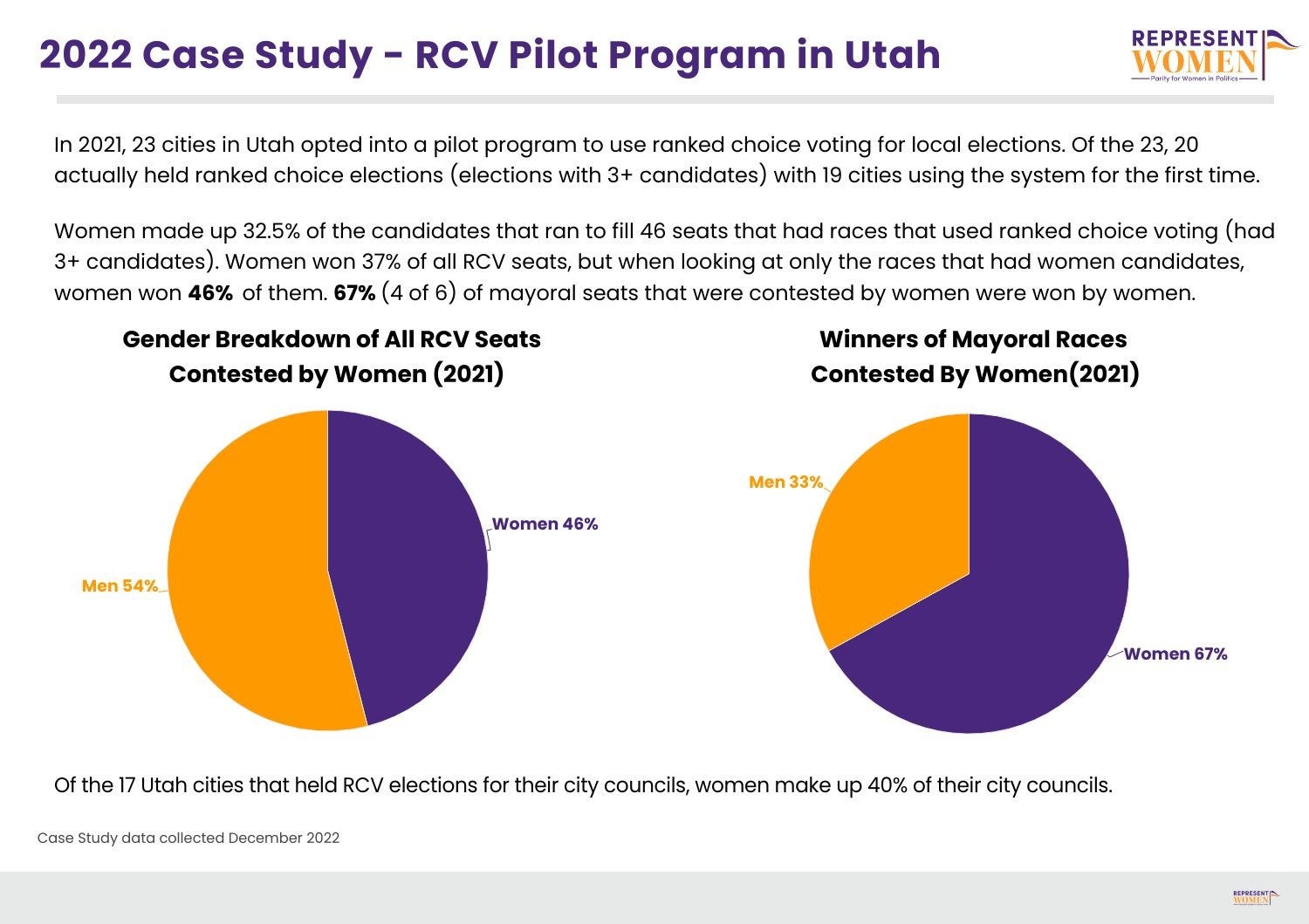
In 2021, 20 cities in Utah held local RCV elections after they opted into a pilot program, 19 of these cities used RCV for the first time. Women made up 32.5% of the candidates that had races using RCV and won 37% of those seats.
However, the data tells an important story when it comes to voters’ willingness to elect women. In the races that had a woman candidate, women won 46% of the seats.
The data is clear, when RCV is implemented, women see more opportunities to run for office and win elections. In turn, the U.S. electorate has the potential to reflect the people it represents, not just the opinions of the usually white, wealthy, male minority.
Improving Voter Choice
As I finished reading through the case studies I outlined above, I wasn’t surprised that RCV helps more women win — what actually surprised me is how much voters themselves state they want this. In a recent report we conducted in partnership with Murmuration, 78% of Americans told us they want more options and more flexibility on the ballot. They want to decide based on their own judgement, not just fall in line behind whoever their party puts up.
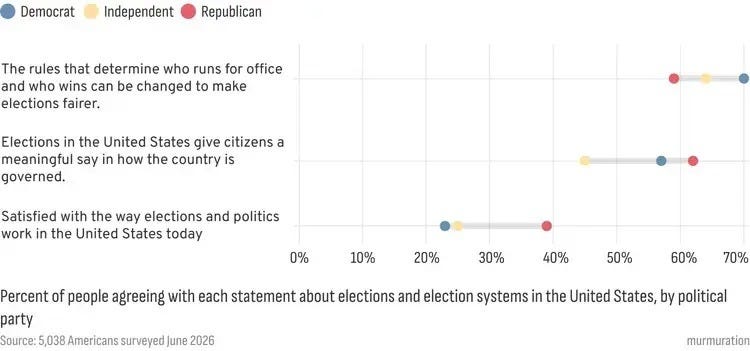
That tracks with what I hear in casual conversations, too. Americans are worn down by a system they know wasn’t built with them in mind, but here’s the thing: they still haven’t given up on democracy itself. Over two-thirds (68%) of Americans are dissatisfied with the current political system, and roughly the same amount (64%) believe that our elections can be made fairer. What struck me most is that this isn’t split among party lines — Americans agree on this even when they agree on little else. Systems like RCV won’t wholly close the gap by themselves, but they’re a real, tested place to start.
Eliminating Barriers for Women
Here’s where all of this research left me: breaking down a system that was built, quite deliberately, to keep power out of the hands of women isn’t a quick fix. Over the last few election cycles, we have seen more women than ever running for public office than ever, with more funding, and more energy behind their campaigns. The U.S. is now slightly over half way to parity.
I expected that to feel like good news. But when I actually sat with the numbers in RepresentWomen’s 2026 Gender Parity Index, I felt something closer to frustration. Progress is slow, and the gains we do make don’t always hold in the long term. That’s not bad luck — that’s a structural ceiling, and women have been running into it since long before any of us got here.
None of this was accidental. Women were written out of participating in our government from the very beginning, and I don’t think undoing that happens by accident either. There’s no single reform that fixes the gap in representation all on its own, no “silver bullet” as some like to say — RCV is just one piece, an important one at that, of a much bigger puzzle.
But researching this one piece changed how I think about my own ballot. It’s not just about how I choose. It’s about whether the system I’m voting in was ever built to let someone like me — or someone who doesn’t look or sound like the people currently in power — walk through the door and actually stay in the room. That’s the case RepresentWomen keeps making with its research, and it’s the case I hope this piece made too: Change doesn’t come from chasing one election at a time. It comes from fixing the structure underneath all of them. And if we’re looking for a structural change that will help women win, ranked choice voting is a great place to start.
%20(3).png)
.png)