%20(3).png)
What Changed in Alabama after the Supreme Court Decision on Callais
Every barrier that makes it harder to run for office, or harder to vote, falls unevenly on women. A recent shift in how the Voting Rights Act is applied is a clear example: when maps get redrawn mid-cycle, women candidates are asked to sustain campaigns they didn't plan for, and women voters are asked to show up twice.
In April 2026, the U.S. Supreme Court decided Louisiana v. Callais, a case concerning how states can use race when drawing congressional districts. The ruling raised the legal bar for challenging a map under Section 2 of the Voting Rights Act, making it harder to prove that a district dilutes the voting power of a racial minority. States that had drawn maps to comply with prior VRA rulings, or that were still defending maps in court, moved quickly to revisit those lines.
What It Meant on the Ground in Alabama
Alabama moved first. Days after the Callais decision, Governor Kay Ivey called a special legislative session to prepare for a return to congressional and state legislative maps that federal courts had already found unconstitutional. Alabama's map had been redrawn once before, in 2023, after a federal court found the state's original map violated the Voting Rights Act. Multiple federal judges, including judges appointed by both Republican and Democratic presidents, later found that the 2023 map itself intentionally discriminated against Black voters, and ordered the state to use a court-drawn map with a second district where Black voters could elect their preferred candidate. The map preserved Congresswoman Terri Sewell’s district as a major Black seat and created a second district, giving Black voters who make up over a quarter of the state's electorate the opportunity to elect another candidate of their choice.
Once courts lifted the injunction against it following Callais, Alabama reverted to that 2023 map, redrawing four of the state's seven congressional districts and eliminating one of the two districts where Black voters, who make up just over a quarter of the state's electorate, had the ability to elect a candidate of their choice.
The practical result was a second primary election, held August 11, 2026, months after the state's regular May 19 primary had already begun under the court-ordered map. Because voting was already underway when the new election was called, more than 40,000 votes already cast were effectively nullified. Candidates who had built a campaign, raised money, and secured volunteers for one election were asked to do it again, on new lines and on a compressed timeline, heading into the November midterms. Voters were asked to return to the polls a second time for the same seat, with no assurance that their ballots would not again be nullified., an added burden that lands hardest on people already stretched thin, including women, parents, and anyone with caregiving responsibilities who can't easily reorganize their lives around a second Election Day. The chilling effect was stark: just 113,493 of the roughly 2.1 million registered voters across the 40 covered counties turned out, about 5 percent, at a cost of around $39 per valid ballot.
This is where redistricting instability becomes a representation problem, and specifically a women's representation problem.
Why This Falls Hardest on Women
Running for office already costs more, in time and in money, than most people can absorb without institutional backing. Women candidates, who on average have less access to donor networks and party infrastructure than their male counterparts, are more likely to be running lean, closer to the margin, with less room to extend a campaign they didn't budget for. Asking a candidate to sustain, or effectively relaunch, a campaign for a second election is asking her to find a second campaign's worth of money and staying power on short notice.
The same dynamic holds for voters. A second election requires the ability to plan around it: to take time off work, to arrange child care, to travel to a polling place a second time. Single mothers, rural women, and women of color are disproportionately less likely to have that flexibility built into their lives. When a state adds an unplanned election to the calendar, it is not neutral. It quietly raises the cost of participating in democracy for the people who already have the least slack to absorb it.
This is what we mean when we describe representation in America as facing a structural ceiling. It is not that women lack the interest or the qualifications to run and vote. It is that the systems built around single-member, winner-take-all districts create repeated points of instability, redistricting fights, mid-cycle map changes, second elections, that fall hardest on the candidates and voters with the fewest resources to weather them.
Other Women’s Voices on What’s At Stake
We're not the only ones connecting this moment to women's political power. Anneshia Hardy, a Montgomery-based narrative strategist, told The 19th that she reads the Callais ruling through a longer history: even after the 19th Amendment extended the vote to women, Black women continued to face racial barriers to the ballot. As she put it, "our ancestors left us a blueprint" to guide the work ahead.
Georgetown law professor Dr. Michele Goodwin made the stakes for women explicit in The Nation, arguing that reproductive rights, childcare affordability, fair pay, and protections for caregivers all depend on the same political power now under threat. As she wrote, "voter exclusion was never about men alone."
A Pattern Other States May Follow
Alabama's case does not stand alone. With Section 2 protections narrowed, other states with pending or prior redistricting disputes may find a similar path open to them, raising the prospect of more mid-cycle map changes and more second elections before the decade is out. State and local officials retain the responsibility to protect fair representation even where federal protections have narrowed, and that responsibility now carries more weight than it did before Callais. Mississippi is now pursuing a similar effort that could eliminate its only Black member of Congress.
A More Stable Design
Winner-take-all, single-member districts are also what make racial and partisan gerrymandering possible in the first place. Every ten years, and now apparently sometimes in between, someone has to draw a line, and that line becomes a target for litigation, revision, and repeated elections. Systems built around multi-member districts with ranked choice voting achieve fair representation for minority communities and for women without relying on a single, contestable district boundary. They are more resilient to exactly this kind of disruption, because representation isn't riding on one line surviving one lawsuit.
Proportional remedies expand opportunity for women. Our research shows that remedies for voting rights violations that address underlying systems, such as proportional voting structures, are among the most effective approaches to improving representation outcomes. In jurisdictions where such remedies have been implemented, governing bodies have become more reflective of the communities they serve, strengthening democratic legitimacy and accountability.
Portland, Oregon offers one compelling example: following the city's adoption of council expansion alongside proportional ranked choice voting as a remedy, women now hold half of all city council seats, and four of the six women elected are women of color, making it the most representative council in the city's history. These outcomes demonstrate what becomes possible when voting rights protections are paired with systems designed to prevent vote dilution and foster fair representation.
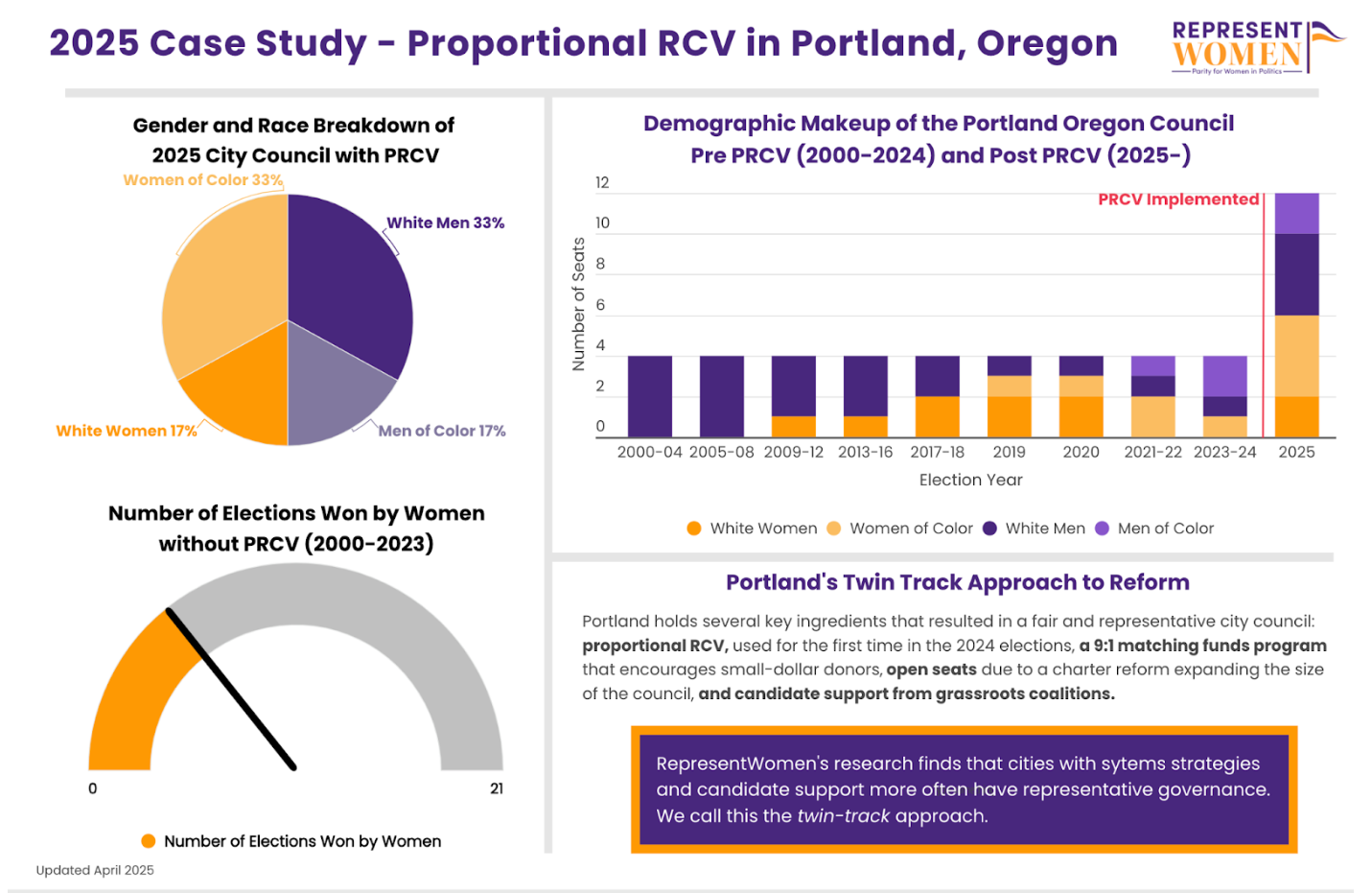
The Fair Representation Act, which would replace single-member congressional districts with multi-member districts elected by proportional ranked choice voting, applies this same logic at the federal level. It offers a remedy that doesn't depend on redrawing a single contestable line every time a court, or a legislature, decides to revisit it, the exact vulnerability Callais exposes.
Visit our website page to learn more about the Fair Representation Act and how it would increase women’s representation.

.png)