
What International Data Tell Us About the Keys to Gender Parity: Inside RepresentWomen’s International Research
RepresentWomen and Fatma Tawfik
Sep 24, 2026

This article was originally published on RepresentWomen's Substack.
One would think that women, who represent almost half the world’s population, would be able to achieve equality after centuries of fighting for their rights; however, according to the United Nations, the world needs more than 300 years to achieve overall equality. In political representation, the world needs 130 years to reach parity in the highest executive offices, and nearly 40 years to reach equal representation in national legislatures.
Gender parity in politics requires more than the usual advice to train more women or to encourage more women to run. While those pieces of advice still carry some weight, they are not enough in today’s world, as they miss the main problem. The issue with women’s representation is not women lacking qualifications or desire, as more and more ambitious women run in elections, but still fail to win or continue in office because of the systemic barriers that they face.
This is why we took a different approach at RepresentWomen. Instead of focusing on the general notion that more women need to run for office, we directed our focus on the whole election process, which includes women running in elections, then winning, serving, and leading. We focus on how the process starts and ends by studying and researching systemic reforms, voting systems, gender quotas1, placement mandates2, and institutional structures to see how each of these factors can pave the way for women in politics or hinder their progress.
RepresentWomen was founded on the premise that progress shouldn’t rely on an individual woman or a single policy, but on the implementation of systemic reforms to address the barriers that face women candidates in their political careers.
This brings me back to a conversation I had with RepresentWomen’s Founder and Executive Director, Cynthia Richie Terrell, about the organization’s mission and why international data is central to this mission, and she said,
“When I founded RepresentWomen in 2018, the United States ranked behind 105 countries, and nearly all our democratic allies, for the percentage of women in elected office. After almost a decade of research, it’s clear that women face structural barriers in politics, as candidates and as elected officials, and that if we truly want to reach gender balance in elected office in our lifetimes, we need to address those structural barriers head-on.
RepresentWomen’s international research is invaluable because it confirms that gender quotas and electoral systems are the biggest indicators of success for women in politics.”
Her point rings even truer today. Despite the U.S. ranking higher today than it did in 2018, it still falls behind nearly all of its democratic allies. In a conversation we had recently about this, Cynthia said,
“I know that the situation is not much better than it used to be when I founded RepresentWomen, but we now have a blueprint for the systems strategies that are most likely to advance women’s representation and leadership.”
Why International Research Matters: A Bridge Between Nations
Learning about democracy and advocating for gender parity is not restricted to one country but is an ever-evolving worldwide challenge. Thus, researching political representation internationally serves as a bridge between nations with different cultures, systems, and aspirations.
It’s also an educational experience for the United States, which currently ranks behind more than 80 other countries in terms of women’s representation in national legislatures. By studying other countries and relying on data-based evidence from those countries regarding which reforms help empower women in politics, like proportional voting systems, ranked-choice voting, gender quotas, and placement mandates, American advocates can look at real-world evidence and study which of them can be applied in the U.S. and might be able to lead to gender parity in the U.S. context and which might not.
Moreover, producing research that mainly focuses on systemic reforms that impact women’s representation internationally provides data-driven evidence to international advocates to help them in their local fight for gender parity.
Thus, our team developed data-driven work and research. In 2021, RepresentWomen launched the Country Brief Series to create individual country profiles on the impact of different systems on women’s representation around the world, set within the context of shared borders and histories between countries. This series included seven installments so far, covering: Post-Soviet Brief, Arab Countries Brief, Latin America Brief, Oceania Brief, European Union Brief, North America Brief, and Central America and the Caribbean Brief.
We didn’t stop at comparing how women’s representation is in different regions, but we wanted to expand by focusing more on specific factors, countries, and special cases. In 2023, we authored the “Voting Systems and Women’s Representation: Lessons from Around the World and the Case for Proportional Ranked Choice Voting in the United States memo” to explain how not all electoral systems can yield equal opportunity for women’s representation. We analyze how proportional3, semi-proportional4, and majority/plurality voting systems5 can impact women’s representation. And how gender quotas play a significant factor in each of these systems. Our data demonstrates the negative impact of candidate-centered systems that create barriers for women and marginalized groups versus the positive impact of system-centered proportional systems that encourage diversity.
This year we updated this memo, which further explores the significance of placement mandates in maximizing the effect of gender quotas on women’s political representation.
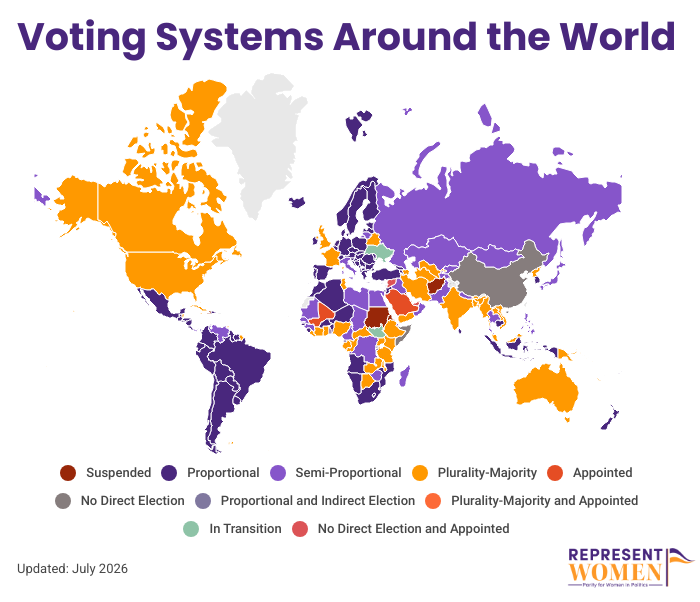
The team also maintains monthly election tracking and updates RepresentWomen’s interactive global graphics. Not only do we predict the outcomes of elections happening worldwide regarding women’s representation based on the systems that they use or any systemic reforms that they implemented recently, but we also track shifts in their international ranking due to the changes in the percentage of women’s representation in their national legislature.
Out of our belief that people are the actual engine of change, not just the data, we created a global network of gender advocates (GAP Network). The network includes a selected group of advocates, researchers, and experts from all over the world who are driven by their passion to achieve gender parity by exchanging experiences and perspectives.
Out of that same belief that people, especially women, are the heart of the democracy movement, we interviewed experts, advocates, and public figures to center their stories and hear what they had to say about the struggles and achievements of women in politics. We interviewed Mary Robinson, Ireland’s first-ever woman president, and explored who she is as a person, her aspirations, and her achievements. We also discussed both the challenges and opportunities facing women in politics in Ireland, where she reflected on how Irish women were the engine that drove the historic win of having a woman president; in this interview, she said, “I was elected by the women of Ireland, who, instead of rocking the cradle, rocked the system.”
We also followed the historic win of Claudia Sheinbaum of Mexico’s presidency and sat down with experts on the matter, Jenneifer Piscopo, Georgina De La Fuente, and Catherine Reyes-Householder, to discuss the reasons behind this win and explore the effect of the parity-in-all gender quotas. After Sheinbaum spent almost five months in office, we conducted another interview to explore how she navigates the struggles of being the first woman president in Mexico and her achievements so far.
Lessons From RepresentWomen International Work:
The road to gender parity is not through individual women or through a single policy or solution but through a combination of intertwined systemic reforms. Based on our research, the ideal system a country can have to achieve high political representation in the legislature for women is combining a proportional voting system with a well-designed gender quota empowered by a strong placement mandate.
- Proportional Representation (PR): A voting system where seats are allocated to candidates or parties in proportion to the total number of votes obtained. This system yields the best opportunities for women as it allows more candidates and political parties to be represented at the same time. It also creates more opportunities for political minorities to be represented through more diverse legislatures.
- Gender Quotas: A temporary special measure that requires that a certain percentage or number of candidates or seats be filled by a specific gender. We found that countries that implement a gender quota, whether reserved seats, legislated candidates, or even a voluntary party quota, usually have better women’s representation.
- Placement Mandates: A quota alone isn’t enough, as political parties usually will bury women candidates at the bottom of the ballot, thus, A placement mandate requires political parties to either alternate positions of candidates based on their gender on their lists (Zipper or Zibra mandate), or requires them to add candidates from a gender in specific spots on the list (adding a woman in the top three spots).
When these three factors are combined, the gender gap in politics noticeably decreases. The average women’s representation in countries that combine a PR voting system with a gender quota and placement mandate is 35%. On the other hand, the average women’s representation in countries with a plurality/majority system, without gender quotas, is only 20%.
Out of 107 electoral democratic countries, 61 countries use a proportional voting system, yielding an average women’s representation of 34%. However, women’s representation rises to 38% in the 28 countries that use this favorable combination. Across the remaining electoral democratic countries that implement other systems, women’s representation in the national legislature declines to an average of 22%.
Sometimes we find exceptions worth studying. In the Central America and Caribbean Country Brief, the case of Dominica brought to our attention how a country can achieve high women’s representation despite having none of the above elements. After diving deep into this case, we found that this high representation stems from the country’s small parliament, a long history of women’s representation, and support from major political parties for increasing the number of women candidates.
Final Thoughts
In the end, the path towards a truly inclusive democracy is neither easy nor does it happen overnight. It’s also not a struggle that a single country can fix in isolation from the world. It requires the blueprint of the best system strategies to achieve parity, provided by data and the power of people. By looking at the world that we live in, we can learn from what other countries have already experienced and draw inspiration from their bold systemic reforms. Until one day we can live in a world where gender parity is the norm, not the exception.
1 Gender Quotas are temporary special measure that requires that a certain percentage or number of candidates or seats be filled by a specific gender.
2 Placement Mandates are mandates that requires political parties to place either alternate positions of candidates based on their gender on their lists (Zipper or Zibra mandate), or requires them to add candidates from a gender in specific spots on the list (A woman in the top three spots).
3 Proportional Voting Systems are systems where seats are allocated to candidates or parties in proportion to the total number of votes obtained.
4 Semi-Proportional Voting Systems are systems that combine elements of plurality-majority and proportional systems. Semi-PR systems are often more representative than non-PR systems because they help to ensure that political minorities are represented.
5 Majority Voting System are Systems that require the candidate to get the majority of votes (50%+1 ) in order to win the seat. If the candidate does not win a majority of votes, a second election is held.
Plurality Voting Systems are systems that broadly allow the candidate with the most votes to be declared the winner. A candidate can win with less than 50% of the vote in plurality systems.
%20(3).png)



.png)