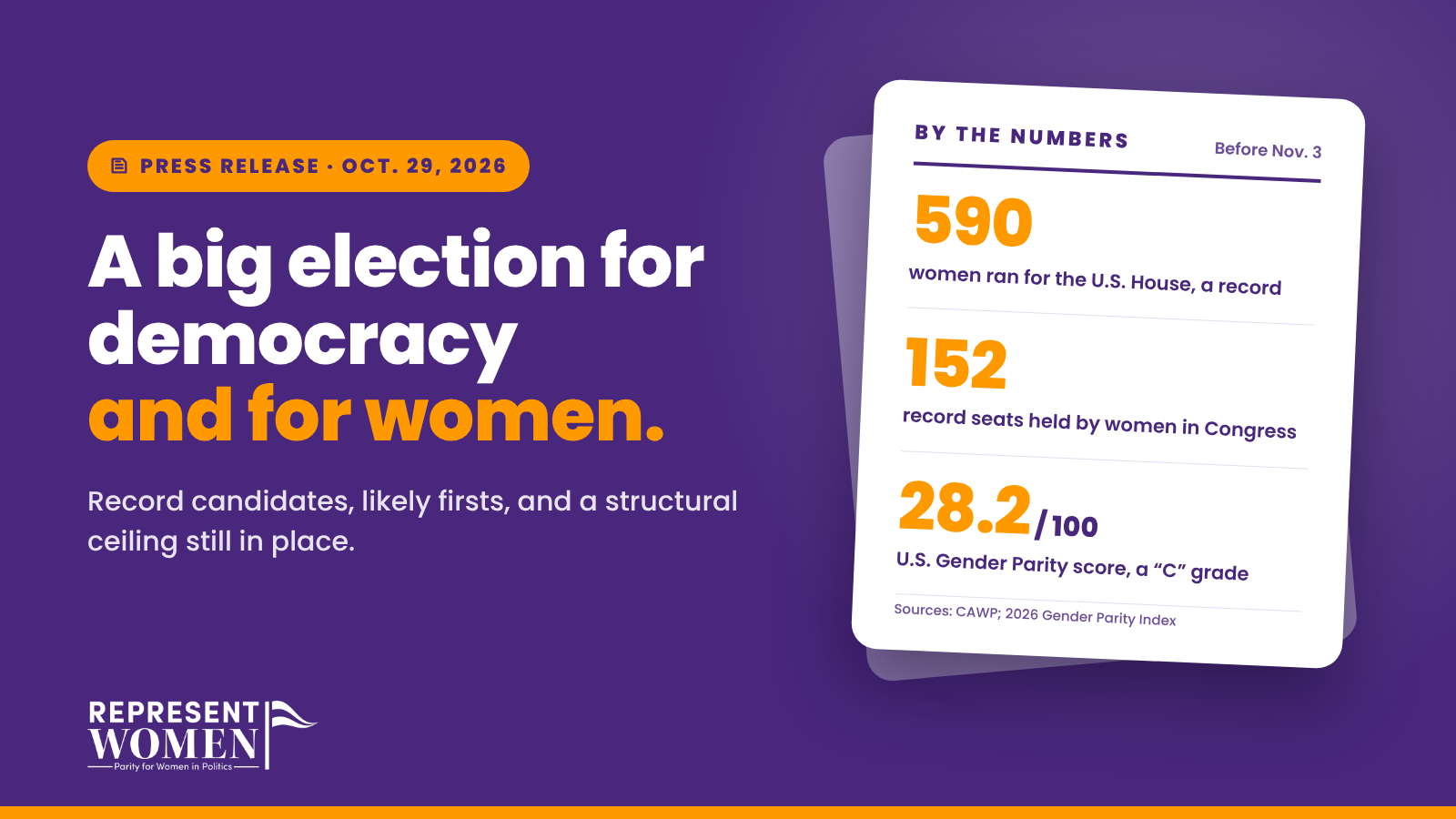
A record number of women ran for the U.S. House this year, and Tuesday's election could produce historic firsts for women in governors' offices and the U.S. Senate. But according to RepresentWomen, a nonpartisan research and advocacy organization, women's overall share of political power may barely move — a sign of the structural ceiling built into American elections.
"This is a big election for our democracy and for women, and those two things are bound together," said Cynthia Richie Terrell, founder and executive director of RepresentWomen. "Women will make history next week, and we'll celebrate every one of them. But we can't celebrate our way to parity. As long as our elections are designed as winner-take-all contests, women's progress will rise and fall with each cycle."
Women head into Election Day holding a record 152 seats in Congress and a record 14 governorships. Yet RepresentWomen's 2026 Gender Parity Index found that women's share of seats across every level of government did not change at all from last year, despite record candidates and record campaign funding. The national parity score stands at 28.2, a "C."
The numbers going into Tuesday, drawn from the Center for American Women and Politics (CAWP), show why:
- A record 590 women ran for the U.S. House, but women are still just over a quarter of all major-party House candidates.
- Seventeen women are leaving the House, and at least six new women governors must be elected just to keep the number of women governors level.
- Women make up 45.5% of Democratic House nominees but just 17.6% of Republican nominees, and Republican women won House primaries at a lower rate than Republican men this year.
What to watch on November 3:
- Possible historic firsts: the first woman governor in Tennessee, Ohio, and Minnesota, the first Native American woman and first Black woman governors in U.S. history, and the first Native women in the U.S. Senate. This could also be the first time that three Black women would serve together in the Senate. That we’re still counting firsts in 2026 shows how rare women’s wins remain.
- The margin by which the gap between Republican and Democratic women widens in this election cycle.
- Ranked choice voting in Alaska, Maine, and Oregon — places with strong records of women’s representation — plus adoption measures in Honolulu, HI; Irvine, CA; and Longmont, CO; and Alaska’s measure to repeal its system.
- New Mexico’s Constitutional Amendment 4, which would end the state’s status as the only one in the country that pays its legislatures no salary.
RepresentWomen notes that in this nation’s 250th year and more than a century after suffrage, the country is still counting firsts. These milestones make headlines precisely because women's wins remain the exception rather than the norm. Parity, the organization says, will arrive when a woman winning a governorship is no longer news.
"Women are not a monolith, and parity can't come from one party alone," Terrell said. "The barrier isn't a shortage of qualified women; it's the design of our elections. Where voters have adopted ranked choice voting, women hold 55% of city council seats, significantly higher than the national average. That isn't luck. It's design."
RepresentWomen's research points to structural solutions. Ranked choice voting works in the elections the country already has, including local and nonpartisan races. Proportional representation allows gains for women to build on one another instead of simply moving from one seat to another. Legislative modernization helps women serve and stay in office. New national polling by RepresentWomen and Murmuration found that Americans' top explanation for why more women don't hold office is barriers within politics itself, not a lack of qualified women.
About RepresentWomen: RepresentWomen is a nonpartisan research and advocacy organization advancing women's political representation through evidence-based structural reform, including ranked choice voting, proportional representation, and legislative modernization. Its Gender Parity Index, published by the RepresentWomen Institute since 2013, is the leading national measure of women's representation across all 50 states. Learn more at representwomen.org.
Contact Communications Director, Alana Persson, for interview requests at alanapersson@representwomen.org.