
The Supreme Court case Louisiana v. Callais could reshape the Voting Rights Act and threaten hard-won progress toward equal representation. RepresentWomen explores what’s at stake for women — especially Black women — and why protecting the Voting Rights Act remains essential to building a truly representative democracy.
For more than a century, every step toward gender equality in America has shared a common truth: lasting progress depends on participation — in elections, in leadership, and in shaping the systems that define our democracy. From the suffragists who fought for the 19th Amendment to the activists who led the Civil Rights Movement, each generation of reforms expanded not only who could vote but also who could be represented.
At RepresentWomen, we continue that work by advancing systems reforms, such as ranked choice voting and proportional representation, which help more women run, win, serve, and lead. But for those reforms to succeed, and for women to be elected, fair representation must be protected.
In that sense, the work to expand voting rights has always been intertwined with the pursuit of equal representation. That’s why we were watching closely as the Supreme Court heard oral arguments yesterday in Louisiana v. Callais — a case that could weaken one of the most powerful tools for ensuring fair representation: the Voting Rights Act.
Here are our reflections on this pivotal moment and what it means for women’s representation, especially Black women, across the country.
What’s at Stake in Louisiana v. Callais — and Why it Matters for Women
For nearly 60 years, the Voting Rights Act has served as the cornerstone of representative democracy, ensuring that communities, regardless of race or background, have a fair opportunity to elect candidates who reflect their interests and shared experiences. Today, that cornerstone is being tested.
Yesterday’s oral arguments in Louisiana v. Callais signaled just how much is at stake for our democracy — and for women’s representation. The case challenges Section 2 of the Voting Rights Act, a key provision that guards against vote dilution by prohibiting racially discriminatory district maps and election practices that weaken the voices of communities of color.
When those protections are strong, women of color are better positioned not only to participate in elections but also to win them, bringing new perspectives and priorities into government. Weakening Section 2 would silence voices already underrepresented in power, particularly those of women whose leadership has long been the backbone of democratic progress.
As Glynda Carr, co-founder, president, and CEO of Higher Heights — the political home for Black women and candidates — reminds us:
“Black women are a powerful force in the American political system, and their political power at the polls and on the ballot continues to grow and is increasingly recognized as the force it is.”
That force — built on generations of civic engagement and community leadership — has reshaped elections and strengthened democracy nationwide. Yet the systems meant to support equal participation and representation have not kept pace.
RepresentWomen’s 2025 Gender Parity Index underscores this connection. The states most affected by this Supreme Court case, especially Louisiana, already lag behind the rest of the nation in women’s political representation. Louisiana consistently received an “F” grade from 2019 through 2023, improving only to a “D” in 2024 and 2025. Despite that modest progress, the state still ranks 44th overall, with women holding just 24 percent of legislative seats and only two of twelve statewide executive offices.
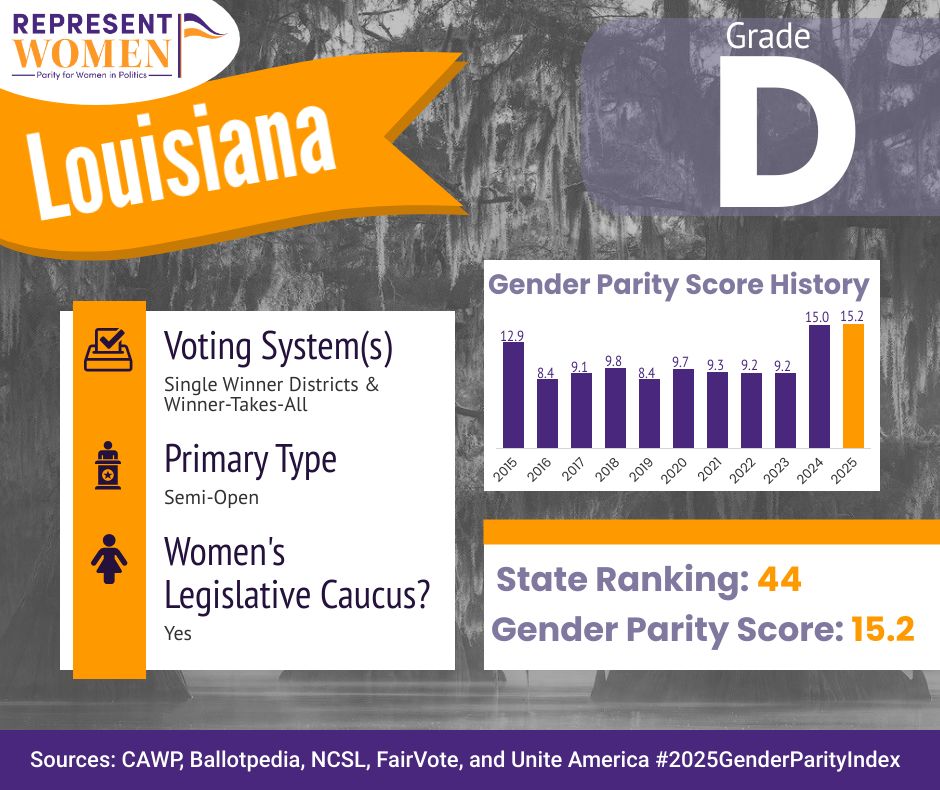
Rolling back Section 2 would not only harm communities of color — it would also threaten these fragile gains and stall the very cycle of progress that moves us closer to parity.
Legacy and Progress: A Mother’s Story, A Movement’s Reminder
As Ashley Shelton, President and CEO of the Power Coalition for Equity and Justice, told the ACLU, fair representation shapes far more than politics itself:
“Fair maps don’t just mean better representation — they can mean safer streets, lower prices, and better schools for our communities. Our democracy cannot function unless all voters have fair opportunities to elect candidates of choice.”
The sentiment expressed by Shelton closely mirrors our own at RepresentWomen. We recognize that the Voting Rights Act is far more than policy —it’s a defense for disenfranchised people and the preservation of their voices. Too often, that human impact is overlooked in national conversations about democracy.
That’s why we so sincerely appreciate the perspective of FairVote’s Lakeisha Steele, Vice President of Federal Affairs and Partnerships, in her piece: Protecting the Voting Rights Act and Our Democracy. Her reflections center these issues where they belong; around voters whose voices and experiences give democracy meaning. For Steele and millions of others, the story of the Voting Rights Act is also the story of women — women like her mother, born in the Jim Crow South, who watched her parents risk everything just to register to vote.
Steele shared memories of her mother’s childhood in Greenville, Mississippi; of grandparents turned away from the polls by literacy tests and poll taxes, and of neighbors living under the constant threat of violence for daring to participate in democracy. As Steele writes:
“These tactics dated back to voter discrimination laws like the infamous Mississippi Plan, which was designed to systematically exclude Black Americans from exercising the right to vote. My mother often spoke about the violence that loomed over the Black community, with the threat of beatings and imprisonment for Black Americans who dared try to register.
As my mother came of age, so did the Civil Rights Movement — with the images of the late Congressman John Lewis coming within an inch of his life on the Edmund Pettus Bridge in Selma; of Amelia Boynton Robinson, beaten unconscious there by Alabama state troopers; of fire hoses and police dogs released on activists peacefully protesting segregation in Birmingham.
This history stayed with my mother for the rest of her life. She understood how precious and fragile our democracy is, and that our civil rights protections were not guaranteed, but instead were demanded and won through blood, sweat, tears, and even loss of life.”
That law transformed not only her family’s life but the lives of generations of women who followed. It opened doors for Black women to organize, to vote, and eventually to lead — laying the groundwork for the political power that women of color continue to build today.
But as Steele reminds us, that legacy is fragile. Each attempt to weaken the Voting Rights Act threatens to undo the progress won through courage, sacrifice, and collective action.
Protecting Progress: Defending the Systems That Make Representation Possible
The Voting Rights Act was one of the most successful democracy reforms in American history; the product of a movement that believed in building systems where everyone has a voice. At RepresentWomen, we share that belief.
Every advancement in women’s political power — from suffrage to proportional ranked choice voting — has been made possible by those who fought to expand access and inclusion. Defending the Voting Rights Act honors that legacy and protects the foundation of representation itself.
As Victoria Pelletier, RepresentWomen’s Programs and Partnerships Manager, former City Council Member in Portland, Maine, and author of the opening letter in Breaking Barriers for Black Women Candidates: A Discussion of Systemic Challenges and Opportunities, reminds us:
“The reality is we won’t make it very far if the framework we serve in is still inherently biased, racist, sexist, and filled with significant barriers. … We don’t have a democracy without Black women, and I look forward to creating an environment where more of us have a chance to run, win, serve, and lead. I refuse to be the last.”
Her words capture what is at stake: the future of a democracy that truly represents us all.
To explore these themes further, watch Breaking Barriers for Black Women Candidates — a powerful conversation featuring Victoria Pelletier, Glynda Carr, and other women leading efforts to create a democracy that works for everyone.
%20(3).png)
.png)