

Ranked choice voting (RCV) is a powerful reform that transforms the way we vote, changing who runs, who wins, and who leads — and increasing women’s political power. Across the country, RCV is breaking down barriers and creating new opportunities for women and diverse leaders to represent their communities.
Under our current system, too many voters feel their voices don’t count. Candidates can win with far less than majority support, women and people of color are often told to “wait their turn” to run for office, and campaigns become increasingly divisive and costly. These structural barriers hinder progress toward gender parity and prevent the government from accurately reflecting the people it serves.
RCV is a proven solution. By eliminating vote-splitting, rewarding coalition-building, and empowering voters to rank candidates in order of preference, RCV creates fairer, more inclusive elections. It strengthens democracy while leveling the playing field for women and underrepresented candidates — and it’s already reshaping leadership and governance in places like Alaska, Maine, and New York City.
Explore our interactive dashboard to see where RCV is already making an impact across the U.S.:
What is Ranked Choice Voting?
This process, often referred to as an “instant runoff,” ensures majority support and eliminates the “spoiler problem.” It allows more candidates to compete on their ideas rather than party politics or fear of vote-splitting. Because candidates benefit from being voters’ second and third choices, campaigns tend to be more positive and coalition-driven. The result is a healthier voter experience, stronger campaigns, and ultimately, better government.
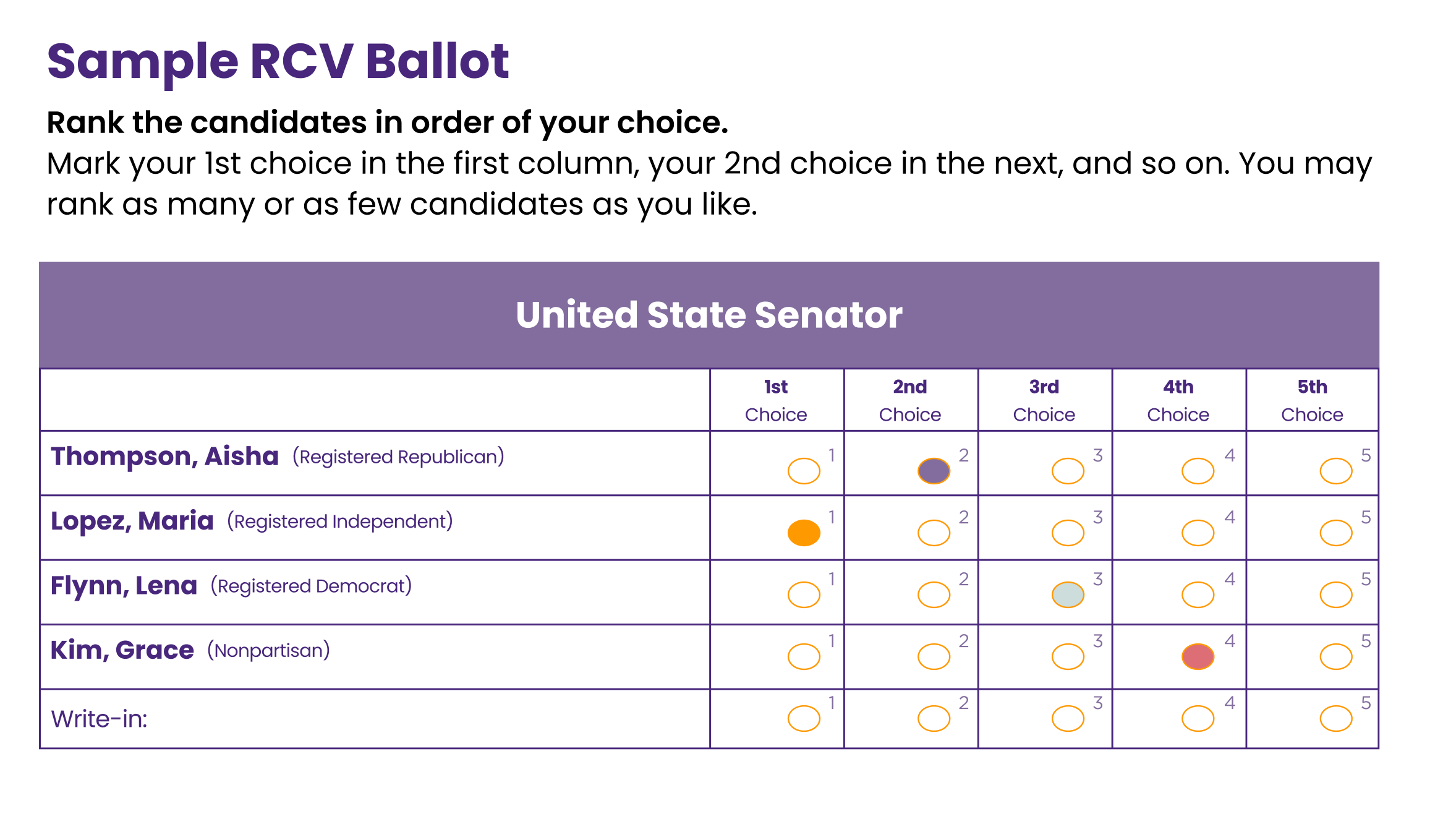
Here’s an example of what that looks like in practice — using Alaska’s ranked choice ballot and the 2022 U.S. Senate race, where multiple women ran and voters ranked their choices to determine a true majority winner.
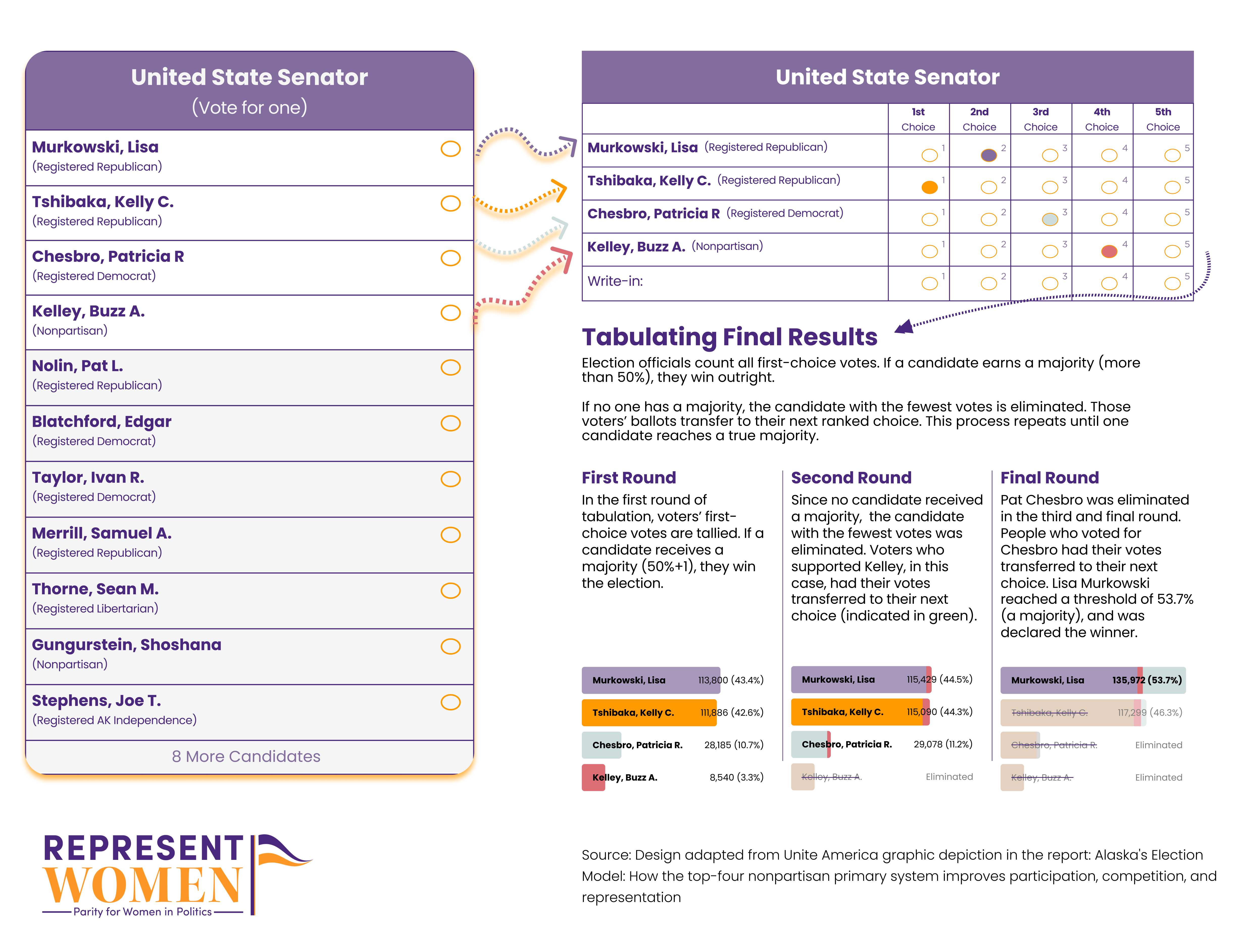
As depicted in the process above, ranked choice voting gives voters the freedom to rank multiple candidates — and in doing so, it opens the field to more competition and a wider range of voices. Under this system, women are not penalized for running in the same race or even from the same party. Instead, voters can consider each candidate on her ideas and values, not just her perceived viability.
In Alaska’s 2022 U.S. Senate race, for example, three of the four finalists were women — Lisa Murkowski, Kelly Tshibaka, and Patricia Chesbro — two Republicans and one Democrat. Under a traditional system, women from the same party might have been discouraged from running for fear of splitting the vote among themselves. But with RCV, they were able to compete on equal footing, giving voters meaningful choices and ensuring multiple women could put their names forward — and be taken seriously — in a single race.
How RCV Levels the Playing Field for Women
Ranked choice voting is one of the most promising tools for advancing women’s representation in the United States. While women make up less than one-third of elected officials nationwide, jurisdictions that use RCV tell a different story. In RCV cities, women now hold nearly half of the city council seats and 40% of mayoral positions — outpacing national averages.
These outcomes aren’t accidental. By removing structural barriers that exist under plurality voting, RCV creates a level playing field where women and underrepresented candidates can compete fairly and win.
RCV addresses some of the biggest obstacles women face in politics:
- Mitigating vote splitting and the “spoiler effect.” Under plurality elections, women are often told to “wait their turn.” With RCV, multiple women can run without hurting each other’s chances.
- Increasing campaign civility. Because RCV rewards candidates for earning second- and third-choice support, campaigns are more positive and issue-focused. Negative attacks — which disproportionately harm women — carry less weight.
- Eliminating costly runoffs. RCV acts as an “instant runoff,” removing the need for expensive, low-turnout runoffs. For women candidates, who often face fundraising gaps, this means fewer financial barriers and more time to connect with voters.
- Boosting engagement and turnout. RCV incentivizes candidates to campaign broadly and across communities, making voters feel more empowered — and more likely to participate.
Together, these advantages explain why women are better represented in RCV jurisdictions than in the country as a whole.
In Their Own Words: Women on RCV
Women across the country are seeing the difference RCV makes. From New York City to Alaska, women leaders point to ranked choice voting as a system that allows them to run authentically, win fairly, and govern with broader support.

RCV in Practice: State Spotlights
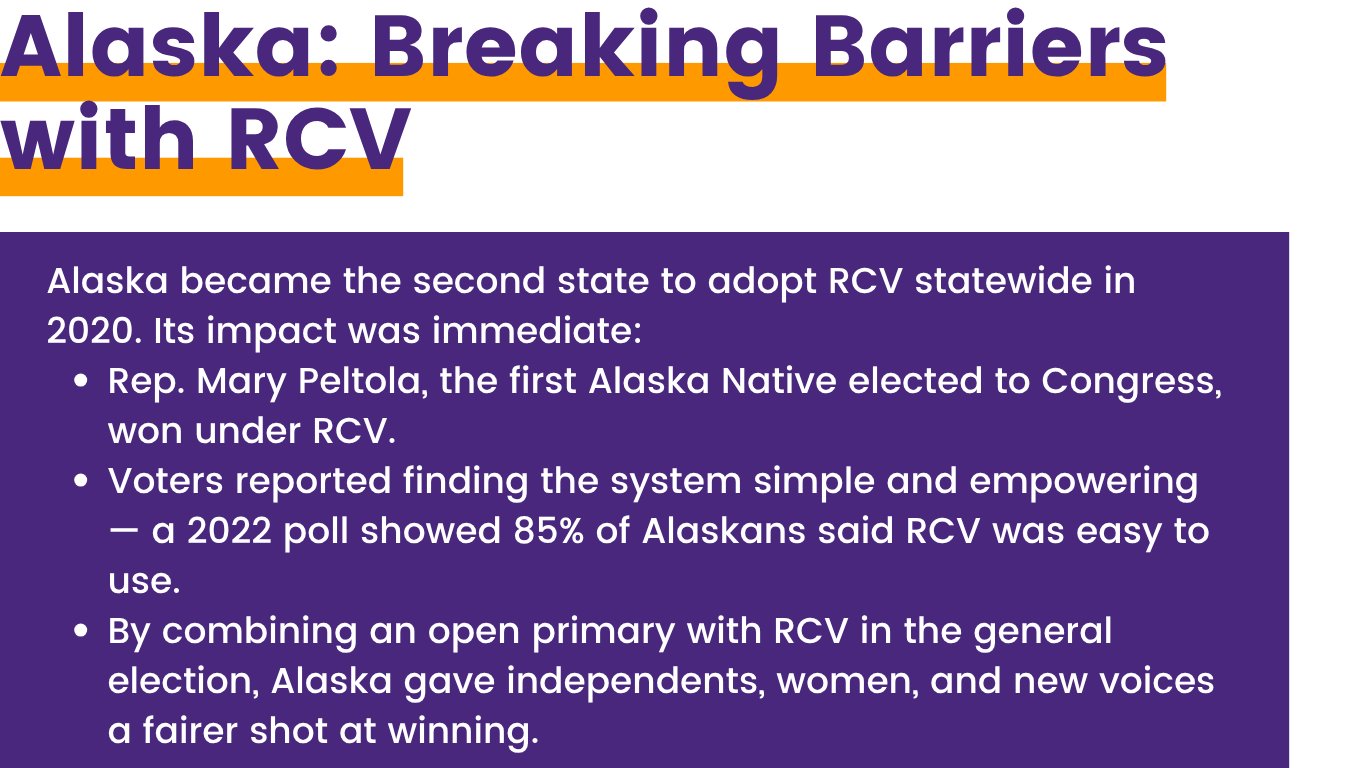
To hear more from Alaska State Senator Cathy Giessel, watch our 2024 Democracy Solutions Summit panel about Alaska's transformative election reform:
Maine: A National Leader in Electoral Reform

New York City: A Case Study in Representation

