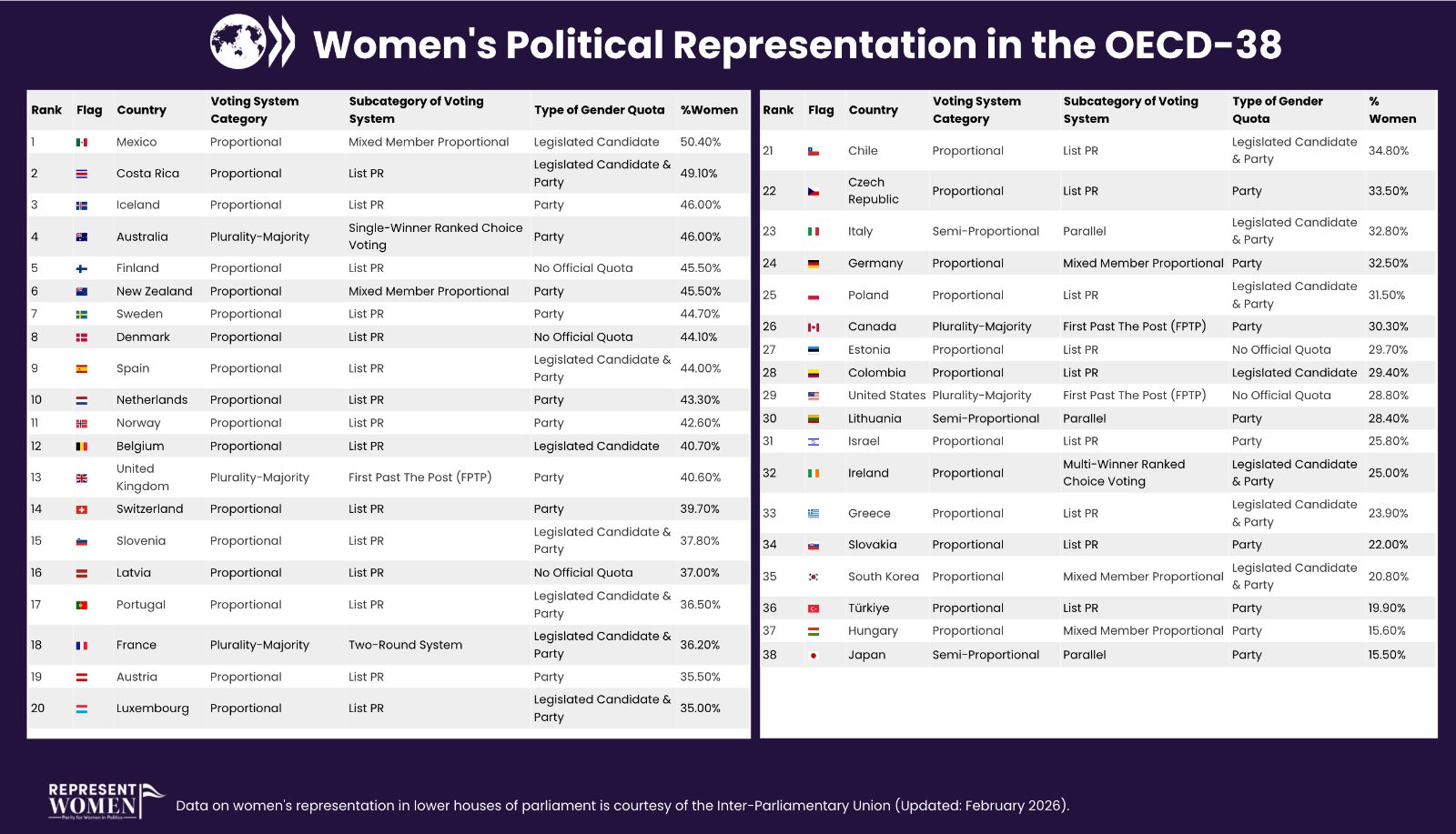
Since 2021, RepresentWomen’s Country Brief series has explored how electoral rules shape opportunities for women in politics around the world. Countries have adopted a wide range of voting systems, gender quotas, and other structural reforms, and their experiences offer real-world evidence of what works, what doesn’t, and why. Across the regions we have studied, a consistent finding has emerged: women’s representation is strongest in countries that combine proportional representation (PR) and well-designed gender quotas and placement mandates. Each installment tests this finding against the specific histories and institutions of a region.
This research reflects a core premise of RepresentWomen’s work: women’s representation is not a result of women lacking ambition or qualifications, but of structural barriers in how candidates are recruited, how votes are cast and counted, and how seats are filled. Women hold approximately 27% of seats in national legislatures worldwide, and at the current pace it will take 130 years to reach parity in the highest executive offices, and nearly 40 years to reach equal representation in national legislatures. Closing that gap requires looking beyond whether women run and instead at the systems that determine whether they win, serve, and lead.
Comparative research is central to this work. No single country can test every reform, but together, countries around the world have adopted nearly every combination of voting system, gender quota, and placement mandate. Studying their experiences allows us to distinguish the forms that reliably advance women’s representation from those that only appear to. For the United States, which lags markedly behind its democratic allies in women’s representation, this evidence offers a blueprint for the systems strategies that are most likely to advance women’s representation.