Building Women's Power: A Mid-Year Update
What does it take to build lasting political power for women in America? RepresentWomen's mid-year briefing offered a clear answer: change the systems, not just the candidates. Founder and Executive Director Cynthia Richie Terrell opened by tracing RepresentWomen's origins as a FairVote project in 2013 and laying out the organization's core belief — that durable progress for women in politics comes from redesigning the rules, not just changing hearts and minds. Just as suffrage, Title IX, the Voting Rights Act, and the ADA re-engineered opportunity for millions of Americans, structural reform is the only path to sustainable gender parity in government. RepresentWomen's research-driven approach focuses on three core levers: building knowledge, setting the agenda, and activating partnerships.
Partnerships powering reform
Partnerships Director Katie Usalis outlined how RepresentWomen supports campaigns and coalitions working on reform — from campaign-ready message tools and women validators to written and live testimony for legislative hearings and task forces. The goal is to ensure women's representation stays centered in every reform conversation, with trusted messengers making the case.
What we offer campaigns & coalitions (Katie Usalis, Partnerships Director)
- Message tools & validators: Campaign-ready assets, women validators, and endorsements tailored to the state/local context.
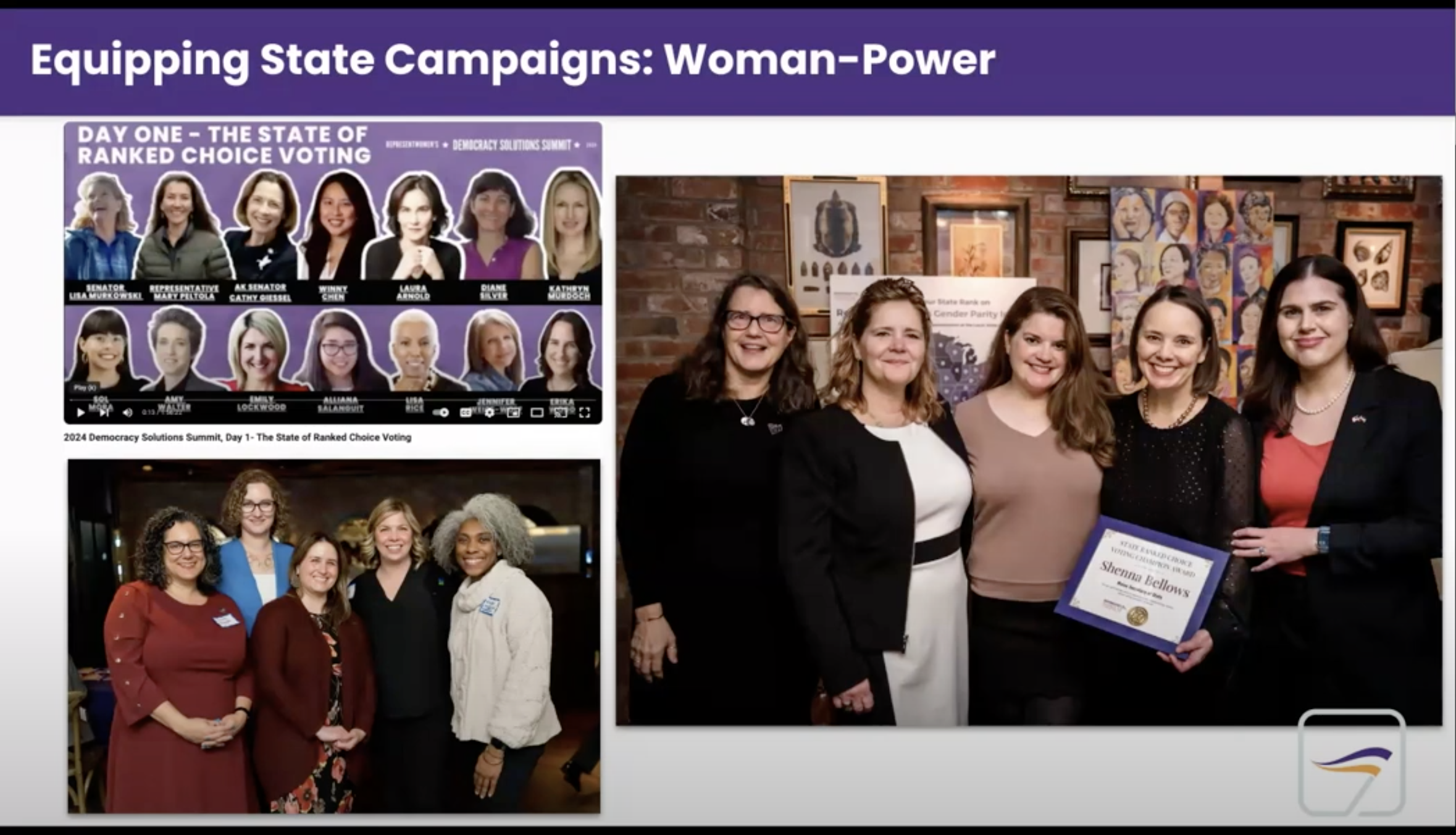
- Woman power: We convene and connect women leaders — Secretaries of State, mayors, and national experts — so reforms like RCV are advocated by trusted messengers.
- On-the-record expertise: Written and live testimony for hearings, task forces, and legislative briefings to keep women’s representation centered in reform narratives.
National Partnerships Manager Victoria Pelletier highlighted two essential tools for advocates:
The Women's Power Collaborative is the only national network uniting women's representation advocates and democracy reformers — with over 150 members across roughly 90 organizations. Members access monthly Lunch and Learns, regional working groups, and a shared library of research and resources.
The Women Experts in Democracy (WED) Directory is a public, filterable directory connecting event organizers, journalists, and advocates with women experts in democracy reform — searchable by location, language, and specialty — to ensure more women's voices are on stages, panels, and in press coverage.
The team also previewed the Seneca Falls 2024 Project — a modern, intersectional Declaration of Sentiments open for partner signatures, paired with a pre-election virtual town hall rally for systems change.
Research highlights
2024 Gender Parity Index (GPI)
Research Director Courtney Lamendola presented findings from RepresentWomen's annual Gender Parity Index, which measures women's representation across four arenas: Congress, statewide executive offices, state legislatures, and local executive roles — scoring each state out of 100, with 50 representing parity. This year's results showed real but uneven progress. Maine and Oregon earned A grades for the second consecutive year, and for the first time, no state received an F. But 26 states still received D grades — a reminder that without structural reform, progress remains fragile and reversible.
Modernizing state legislatures: Pay & retention
Research Manager Steph Scaglia presented new findings on legislative pay — an often overlooked but critical factor in whether women can afford to run, serve, and stay in office. The brief examined how compensation commissions in states like Pennsylvania, Kansas, and New Mexico are helping depoliticize salary decisions and create more sustainable pathways for women in public service.
Breaking Barriers for Black Women in Politics
Research Associate Marvelous Mwansa presented the latest installment of RepresentWomen's ongoing series, identifying the top systemic barriers facing Black women in politics — party recruitment gaps, traditional funding norms, and winner-take-all voting rules — alongside the evidence-based reforms that can address them. These include early recruitment and mentorship targets, race and gender-balanced donor practices, public financing, and ranked choice voting to eliminate spoiler dynamics and better translate community strength into seats.
International lens: What works abroad
International Research Manager Fatma Tawfik shared findings from RepresentWomen's global research, highlighting the most effective combination for advancing women's representation worldwide: proportional representation paired with gender quotas. Countries using both systems average roughly 32% women in parliament, compared to just 17% in first-past-the-post systems. The team is tracking elections across Mexico, India, and beyond as part of ongoing regional briefs and monthly global dashboards.
RCV in 2024: Measures & momentum
With statewide RCV ballot measures in Oregon, Nevada, Idaho, and Colorado — plus local measures in cities across California, Colorado, DC, Illinois, Minnesota, and more — 2024 is shaping up to be a landmark year for election reform. The team also highlighted Alaska, where a repeal effort is on the ballot despite strong early evidence that the state's open primary and RCV system has delivered more voter choice, healthier competition, and more women stepping forward to run. Below is the breakdown:
- Statewide ballots:
- Oregon (RCV statewide + local option),
- Nevada (final approval of a constitutional amendment),
- Idaho (Alaska-style open primary + RCV general),
- Colorado (statewide exploration).
- Local ballots: Multiple cities across CA, CO, DC, IL, MN, and more.
- Alaska: A repeal effort is on the ballot—despite strong early evidence: more choices for voters, healthier competition, and more women stepping forward.
Philanthropy spotlight
RepresentWomen is grateful for the support of funders who share our long-horizon vision. Carla Bernal of Pivotal Ventures offered remarks on why Pivotal invests in RepresentWomen's work, because electing more women requires fixing systems: voting methods, legislative workplaces, and the rules that gatekeep power. We are also deeply grateful to Democracy Fund and Crimsonbridge, whose partnership fuels our research, coalition-building, and advocacy work.
The moment we’re in
With a historic presidential race reshaping civic energy across the country, RepresentWomen remains focused on the same north star: a healthy democracy requires equal representation. That means stronger candidate pipelines paired with the structural reforms that make women's leadership viable, sustainable, and safe — across parties, regions, and identities.
How you can get involved
- Use the WED Directory to book women experts for events, media, and training.
- Join the Women’s Power Collaborative to co-create strategies and share resources.
- Back RCV campaigns in your state or city; amplify women validators and data.
- Champion legislative modernization (pay, benefits, schedules, childcare) to retain women in office.
- Share the 2024 GPI findings to keep states accountable for progress.
Thank you to our speakers, partners, donors, and the hundreds who joined live. Together, we’re building the systems that build women’s power.
.jpg)